Friday, December 8, 2006

EspaƱola: Gardner seamount

We start the day with a great dive at Gardner sea-mount: several marble stingrays hiding in the sand or under overhangs, eagle-rays in the blue and a small school of about twenty golden cow-nose rays flying by! Not to mention two huge jackfish.

Not so great is that I've lost my group... they just disappeared into the blue and did not come back to the reef as agreed in the pre-dive briefing. So I surface alone, amid 2m swells. No land nor zodiac in sight. Before deploying my SMB I blow my tank-pressure-powered horn. While pretty shrill it sounds rather meek in the middle of the ocean. No worries though, a bit later a zodiac appears. And moves on without picking me up! Because I belong to the white team, and it's the yellow team's zodiac... I'm still bobbing there in disbelief when the green team's zodiac passes by and just leaves me there too. Incredible. They do return however once they've picked up their team members and remain by my side until my own zodiac finally arrives.

The second dive, at the same place, is even better than the first one. First a squadron of six eagle-rays passes by within shooting range. Later followed by another one of five. And I get to see some more marble rays and sea turtles too.

 Eagle-rays
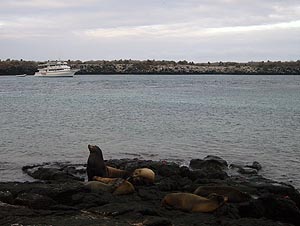
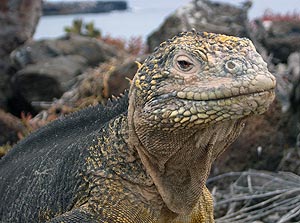
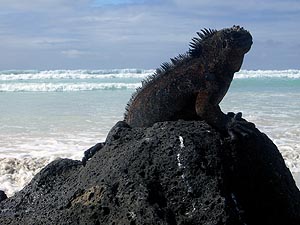
Long sunny walk at punta Suarez, where we get to see the usual inhabitants: sea-lions and marine iguanas. The iguanas have red flanks here, due to their diet consisting primarily of red algaes. We also get pretty close to masked and blue-footed boobies. The latter have an elaborate courtship ritual that we're luckiy enough to witness: the male slowly lifts one foot after the other, in a funny dance, the female -if interested- mimicks his steps, he then raises his beak straight up in the air, as well as his tail and wings, to see if she really means it, if she does she'll mimick him again. After repeating this a number of times, confirming their partnership, they'll then get a bit more romantic by touching beaks and picking up twigs. Pretty cute.

Blue-footed boobies
Further on, we also sight a few waved albatros, the last ones of this breeding season, as most have already taken off.

Thursday, December 7, 2006

Floreana: Enderby & Champion

Early dive at Enderby followed by a land tour at punta Cormoran. There's a shallow lagoon there, with about 30 flamingos. We are lucky enough to witness a courtship parade by a bunch of stiff-walking head-turning cackling males. A rather funny spectacle, that no female seems to be interested in. In a nearby bay, at least half a dozen turtles are hanging around, resting, waiting for nightfall to crawl up the beach and start their labour. December and January are the egg laying months here for sea turtles.

 Flamingos
Second dive, a little after two, is at Champion. The sun's out. The water's a nice 26°C. Visibility about 10m. Turtles, some schooling fish, a bunch of white-tips, a dark marble stingray and a playful sea-lion at the end. Not bad.

Wednesday, December 6, 2006

Santa Cruz: Gordon's rock

First action dive of the trip, starting with a rough entry & speedy descent. A lone hammerhead shark in the blue keeps a safe distance. A handful of white-tip reef sharks swim by below. I take my first shot at another hammerhead coming a bit closer. But alas not close enough. A sea-turtle wanders by. Followed by a sea-lion speeding towards who-knows-what. Probably just showing off again.

I decide to skip the second dive, held at the same place, to get a bit of a rest. There're plenty more diving days ahead.

Tuesday, December 5, 2006

Santiago: Cousin's rock

Busy day. Starting with an early morning wet-feet landing on a black-lava-sand beach. Home of -you'll never guess- marine iguanas and Galapagos sea-lions. The more special thing about this island however is that it also houses the smaller nocturnal fur sea-lions, which during the day time usually hide in crevasses & cliff-side holes.

Pre- & post-lunch dives are done at Cousin's rock. The main thing here being a large & dense school of striped salemas. A white-tip reef shark cruising by adding a bit of spice.

Just before sunset we go for a little climb on Bartolome island to enjoy the view of the surrounding volcanic landscape.

Monday, December 4, 2006

Isabela: Tagus cove

After breakfast we suit up and hop in the zodiacs for the short ride from the ship to today’s prime dive spot: Tagus cove. It’s 8:04 when we roll into the instant-wake-up 19°C cold water. Luckily my double 7mm wetsuit does keep me cozy if not comfy.

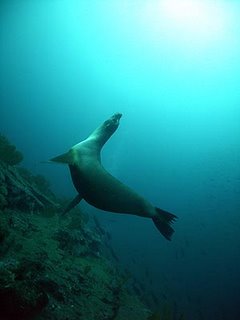
We’re soon rewarded for our bravery: playful sea-lions swim by and I actually manage to keep one’s attention for more than a second by performing some acrobatics too, which, though they must appear as slow-motion clumsy turns to a sea-lion, quickly have me sucking hard on my regulator.

 Sea-lion
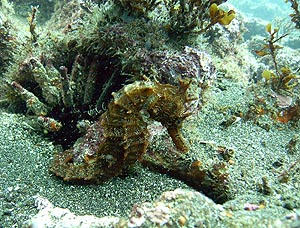
Still recovering my breath, I then turn my camera to some much calmer creatures: three pretty large seahorses, one of them clearly pregnant.

 Seahorse
Two hours after the first dive we’re back again. This time I also get to see several stingrays, a sea-turtle, a pair of small penguins passing by just above me before plunging down in hunt-mode and a flightless cormorant torpedoing by, chasing some unidentified small fish.

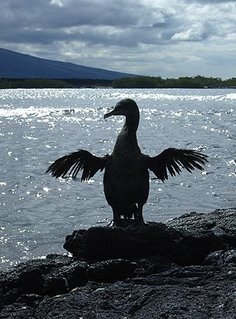
Afternoon walk-about at Punta Espinosa on Fernandina island. The place is crawling with marine iguanas, huddling together by the dozens, in harems jealously guarded by head-shaking salt-spitting males. Flightless cormorants are drying their useless wings.

 Flightless cormorant
18:00, we're sailing over the equator as the sun sets and the moon rises above the volcanoes. Another world indeed.

Sunday, December 3, 2006

Genovesa

We start the day with an early dive, rolling over into a choppy sea at 7:02. It doesn’t take long before a sea-lion joins us, showing off with some incredible underwater acrobatics. Shortly thereafter a hammerhead shark cruises by nonchalantly. In less than 20m of water! They’re not usually seen that shallow, at least not in other parts of the world. And that’s just for starters. As I turn around, an eagle ray flies by down below and a golden cow-nose ray hurries past towards... -I can hardly believe my eyes- a whole school of at least fifty golden cow-nose rays approaching from the opposite direction. And all that before breakfast!


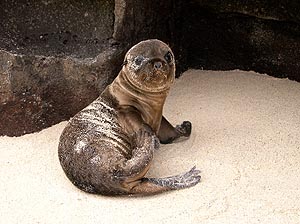
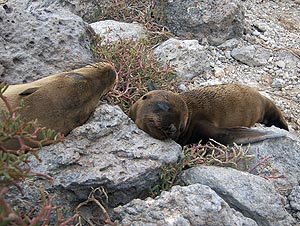
After a fortifying breakfast, Victor takes us for a land tour on Genovesa. We land on a small beach amid a sea-lion family with several cute puppies. Swallow-tail gulls are nesting right beside the path. These are the only gulls in the world that hunt at night. They share the island with masked boobies, red-footed boobies, frigate birds, Galapagos doves and herons. Most of them within touch distance, unafraid of man.

 Sea-lion puppy
After an amazing first dive, the second dive, at 15:05, in Darwin’s bay, is rather boring, with nothing worth mentioning. But then, with a visibility of about 5m, it’s hard to see much.

Saturday, December 2, 2006

M/Y Reina Silvia

At 7:30 I’m transferred to the airport by pick-up, mini-ferry and bus. Pausing along the way for a quick look down one of the pretty deep Gemelos sinkholes. The plane bringing in the other guests is late, but Victor, the main guide, looses no time rounding up everybody and organizing the move to Baltra’s harbor. There, the Gobierno Provincial De Galapagos lets us through without a word and we jump onboard a zodiac for the short ride to the M/Y Reina Silvia, our live-aboard for the next two weeks. We are fifteen tourists on this trip: nine German, one Polish and four Swiss divers, besides yours truly. To take care we get around, get fed, get to see a lot without getting lost above or under water and return happy are ten crew members: captain, first & second mate, cook & assistant, waiter/barman, engineer & assistant, deck-hand and two guides.


Being alone, I get to share a compact cabin with Piotr, a sympathetic Polish guy, who’s also appointed as my dive buddy on this trip.

After a three-course lunch, we’re thoroughly briefed about everything, prepare our gear, suit up and step into the 24°C water directly from the stern of the ship, by now anchored between the two small Plaza islands, on Santa Cruz’s east coast. Just for a short check dive, to get wet and make sure everything is working and we’re properly weighted. In my case that means 6kg of lead, in addition to my 4kg stainless-steel backplate! But then, I’m wearing a very buoyant double 7mm wetsuit.

 M/Y Reina Silvia at Plazas
We dive along a shallow coastal edge with sandy bottom. Viz is poor, about 10m. There’re some fish around, but nothing too interesting except for two turtles and a stingray. The sea-lions all seem to be sleeping on shore.

 Sea-lion puppy with its mommy
Shortly after the dive we do a quick walk-about on Plaza sur, the same place I visited two days ago. So I get to see the sea-lions again anyway :o)

Thursday, November 30, 2006

Plaza sur

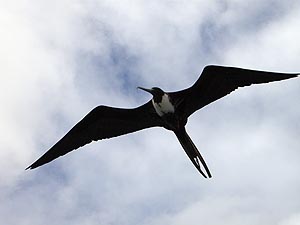
Today I joined a tour to Islas Plaza (63$ incl.lunch). More specifically to the southern one of the two islands. Together with sixteen other tourists and two guides, we first drove for almost an hour across Santa Cruz, passing through several vegetation zones, then boarded the Santa Fe II, a small boat, for the cross-over to Plaza sur, a 90' sail. Along the way, frigates suddenly start flying close besides the boat. The reason's soon clear: at the stern, the cook is cleaning some fish for lunch.

 Frigate
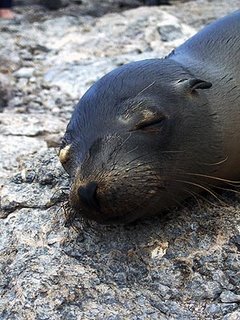
As we approach our landing place, we are greeted by barking Galapagos sea-lions. Dominant males each cruising their stretch of shore, keeping an eye on their harem. Females sunbathing among the big rocks, feeding their young. Puppies waiting for their mommy to return. Plaza sur is indeed home to a whole colony of sea-lions. And I can get real close to some.

 Sea-lion
Besides these, on the surface, very lazy animals, there're also plenty of land & marine iguanas and several kinds of sea-gulls nesting on the steep cliff-side of the island.

 Land iguana
Note that day-trips like this one are not the best way to see the Galapagos. Unless you don't mind spending most of your precious time in transportation to & from the various islands. But, if like me you've got a few days to acclimatize before the real show, then of course it's an option.

Wednesday, November 29, 2006

Santa Cruz: Tortuga bay

It's a 45' hot walk from the hotel to Tortuga bay, along a paved path cutting through dense scrubs and cactus trees. There's a great beach there with some surf. As I approach some black lava rocks, my eyes suddenly focus on something that moved. And it's not alone. Perfectly blending in with the rocks are at least a dozen marine iguanas, absorbing the sun's heat. I'd say the bigger ones are about 75cm.

 Marine iguana
Later on, walking along the beach, I notice more of them lazing in the sand. 15' later I come to a protected lagoon, where it's possible to swim around without being pulled down by the dangerous under-tow. The sun's burning by now. Good thing I put on some sunscreen and brought a bottle of water.

Tuesday, November 28, 2006

Santa Cruz: Puerto Ayora

Sea level. Plenty of oxygen in the air. And with a temperature of about 25°C, it's a nice bit warmer too. To get down here from Quito took me almost 7 hours by SUV, plane, bus, mini-ferry, bus and taxi. I'm not sure they knew I was coming at Hotel Silberstein, but I got a room anyway. From the hotel it's only a short walk to the Charles Darwin station, where I saw some pretty ugly giant tortoises and some very cool golden land iguanas, frigate birds gliding in the sky high above and pelicans flying by just above the cactusses.

The cost of living seems to be surprisingly low here. For only 3$ I had an almuerzo in "Rincon del Alma", a small family run place. Nothing fancy, just honest home-made filling food for hungry travelers. And pretty good value, considering I got a glass of almond milk, a bean-potato-cheese soup, rice with fried platane and meat stew and a flan as desert. 1/2l of water costs 35cents. 1/2l Gatorade 1$. Internet 2$/hr. Ecuador uses US dollars as currency.

Puerto Ayora is the main town on Santa Cruz, the second largest island of the Galapagos.

Monday, November 27, 2006

Quito

After a 28 hour journey by car, 2 trains, 2 planes and SUV I find myself in Quito, capital of Ecuador, a small country on the north-west coast of South-America. Located on the eastern slopes of the Pichincha, a 4794m high active strato-volcano in the Andes mountains, Quito, with an elevation of 2808m, is the second highest city on this planet. (Tip: To avoid altitude sickness, it's recommended to drink a lot.)


I arrived here yesterday evening, the plane litterally landing in the middle of the city, narrowly streched out over 50km between the mountain flanks.

I'm only here in transit though, a short stop-over before continuing my journey tomorrow morning, to the Enchanted Islands...

Curious about what a guy like me does when having a resting day? At 6:30 I enjoyed a nice buffet style breakfast, while the clouds drifted over the city and planes started coming in. At 8:30, in order to loosen up my travel-cramped muscles, I did 50' of fitness in the hotel's gym, followed by a warm relaxing bath and cooling rest. Then, at 10:30, to get at least a sense of the city and its people, I chartered a taxi for a private city tour. Pepe, the cab-driver, driving me by the most interesting places while giving me some background info every now and then. En EspaƱol. Two hours, 25$. That's about as much culture as I can take in a jet-lagged day :o) Back at Hotel Quito, I then had a decent, though at 15$ rather pricey, buffet style lunch. Followed by some blogging (3$/hr). At 16:00 I got a 50' massage to relax some more. Having been warned several times to be very careful outside, and there not really being anything nearby that looks like a nice place to eat, I decide to call room-service around 19:00... Bad choice. Must have been the worst burger in my life :o( Wake-up call tomorrow is at 5:30, so a night in town is out of the question. Not really a problem as there's a 6 hour time difference with Europe, and at 20:00 I'm about falling over.

Monday, May 15, 2006

Bangkok: Last day

I repacked once again. This time resulting in an 11kg city backpack and a 28kg gear bag. Luckily they didn't charge me for the overweight. The taxi ride to the airport, arranged through the guesthouse for 290 THB, took 45' using the normal road (not the expressway). There's a 500 THB departure tax. The duty free hall is fairly big but rather uninteresting.

Sunday, May 14, 2006

Bangkok: Chatuchak weekend market

From the Khao San road area the easiest way to get to Chatuchak is by taxi (80 THB). Once there you can wander around the vast covered market area for hours. They sell all kinds of things here: clothes, household stuff, silverware, amulets, souvenirs, furniture, ... and of course food. Quite an experience. A must see really.

For a totally different shopping experience you can head to one of the big up-scale shopping centers like Siam Center/Paragon or the more popular MBK complex. In the former I had a nice cafe latte and muffin in Starbucks, for 135 THB. And in the latter I enjoyed some great Japanese food (sushi, tempura & soup) and sake, for 420 THB.

It's quite amazing actually how fast you can move from one price range to another, eating for 30 THB, then dining for 600 THB, just by walking to another street. And as you can imagine, I didn't even come near the really expensive places...

Saturday, May 13, 2006

from Hua Hin to Bangkok

There's a 2nd class AC bus leaving Hua Hin for Bangkok every half hour. The ride takes about 4 hours and costs 160 THB (including a small bottle of water). From Bangkok's southern bus station it's a 15' taxi ride to Khao San road (55 THB by meter, 200 THB if you listen to the touts).

Before leaving Bangkok, I'd left my heavy dive gear at New Siam guest house for 15 THB/day, allowing me to travel light. A real luxury! At New Siam, prices vary from 240 THB for a single fan room with common cold water shower to 550 THB for a double AC room with private hot water shower. Breakfasts here are decent.

For nice food I can recommend the Baan Sabai hotel & restaurant. It still has some colonial atmosphere and a quiet terrace.

Wednesday, May 10, 2006

Hua Hin

Hua Hin is a modern coastal city, only 2 hours south of Petchaburi (30 THB by 3rd class fan bus), fully geared towards tourism, both Thai and foreign. Its long beach is completely lined up with private properties, towering condos and tourist class resorts. While this may not sound too great, in a way it's actually nicer than over-built and over-crowded Koh Tao. At least if you find the right place.


Baan Talay Dao resort is a fairly new and relatively small place with accomodations varying from comfortable studios to deluxe suites, just a couple of kilometers south of town. I stayed here three nights, enjoying buffet breakfasts, walks along the beach, the refreshing swimming pool & jacuzzi, the peaceful lush garden setting and dinners overlooking the beach... all that for about 80 USD/day, all included. The restaurant serves delicious Thai food and pretty decent steaks.

Monday, May 8, 2006

Petchaburi

Just a short 3rd class train ride (3h45, 138 THB) from Bangkok lies Petchaburi, a town off the main tourist maps, where people still smile at you and offer help without being asked. I stayed in a no-name Chinese hotel, in a basic fan room with common cold water bathroom for 200 THB.


The town is full of wats (= temples), one of them on top of a small hill, where monkeys rule without mercy. Vendors actually sell corn and bananas to feed them. And they know it. It's strongly advised NOT to bring anything in a plastic bag unless you want to get rid of it. I personally witnessed several take-away strategies.

Strategy #1: A medium sized monkey nonchalantly strolls towards you, looking the other way, as if interested in something in the trees. But as it passes by your side, it suddenly turns around, snatches your bag away and leaps off to examine its catch.

Strategy #2: An alpha monkey comes towards you without a trace of doubt, its purpose clear: your plastic bag. In this case I was holding the bag and cleared it away from its grabbing hands. Having missed the bag, it then jumped straight onto me to get another go, baring its teeth to warn me not to fool around. At which point I conceded and it ran away with its booty: a couple of sweet cakes and a botlle of water - which it expertly opened to have a gulp after having gorged on the cakes.

Strategy #3: When a tourist is stupid enough to buy monkey food, why wait till he/she actually gives it to you? As the vendor hands over a couple of bags of corn to an unsuspecting (Thai) tourist, a big female monkey jumps in and runs off with both bags crammed in her arms.

Sunday, May 7, 2006

Bangkok: Wat Pho

Dressed in shorts I wasn't allowed in the Royal Palace, but I could enter Wat Pho (entrance fee: 50 THB), the temple of the oversized golden reclining Buddha. There're quite a few other temples and stupas on the grounds and several stone statues of fierce looking guards.

Friday, May 5, 2006

Bangkok: Khao San road

Khao San road & surrounding streets truly are a phenomenon. So much so that they've become a tourist attraction. It's much more alive than Charoen Krung road where I stayed upon arrival. Not only because of all the backpackers from all over the world, but also because you can easily get away from it all by submerging yourself into the bustling city life just a couple of streets away. Off the main tourist streets, you can get a street side meal for 20-30 THB. A fraction of the price you pay in the places catering to tourists.

Wednesday, May 3, 2006

from Koh Tao to Bangkok

After 3 days of doing nothing but sleep, eat, read and walk along the beach at sunset I finally got myself together to leave the island and bought a joint ticket (ferry-bus-train, 2nd class AC upper bunk) for 1080 THB.

The Songserm ferry is pretty terrible, its aircon being set to deep-freeze, chasing everybody up to the windy roof for the 3 hour crossing. From Chumporn pier to Chumporn train station it's only a short 10' bus ride. Dinner in the nearest eatery, as I really don't feel like lugging my 40kg of gear around town. The express train leaves on time, and I'm actually able to get some sleep before arriving in Bangkok around 7:15 (only 45' late). From the station its a 50 THB taxi ride to Khao San road.

Shambara guesthouse is full, so I head over to another backpacker street nearby, and end up in the Bella Bella guesthouse. Basic twin room with fan and common cold water bathroom, 270 THB. I'm totally drenched in sweat by the time I've climbed the stairs to the fifth floor. But, it's quiet up there, and there's even a view of Bangkok's rooftops. Eggs, toasts and coffee breakfast costs about 70 THB. Internet access is cheap at 30 THB / hour and burning a CD only costs 100 THB.

Saturday, April 29, 2006

Koh Tao: Jamahkiri health spa

Just to sweat a little bit more I went to a herbal steam sauna, then, in order to cool down again, I got smeared in with aloe vera gel and wrapped up in a sheet to relax, followed by a face cleaning treatment and a jasmin oil massage. All in all 2h30 of special attention, for 1750 THB at the Jamahkiri spa & resort. Because I'm worth it :o)

Friday, April 28, 2006

Koh Tao: Like a flying fish

Shortly after I arrived on Koh Tao, an ad in one of the restaurants caught my eye. It was about a flying boat. The place being close to where I stayed I went to check it out and met Rafael, Israelian, owner of the shop, pilot and instructor, who was happy to answer all my questions. So now, three weeks later, after having done all my deep wreck diving and Bjarne's OW course, I showed up again and made arrangements for a little trial flight (about half an hour for 2800 THB only). As passenger of course.


Rafael set-up and prepared the FIB (Flying Inflatable Boat) did his pre-flight checks, got the boat pulled into the water and off we went!

After taxiing for almost 10' to get the right wind we effortlessly took off, rising higher and higher above the sea. Whow! Then we skirted the island's coastline for about 25' before smoothly landing back in Mae Haad bay.


The FIB only takes two people (incl. the pilot), securely strapped up, with a visored helmet and earphones for in-flight communication. Not that I said much, as I was just too enthralled enjoying the view.


Yeah, I could imagine myself learning to fly one of these. Just for the fun of it. Apparently it only takes about two weeks to learn (consisting of theory, about 15 hours of duo flights, 3 hours of solo flights & exam - all that for about 2000 USD).

I was not allowed to bring my own camera, to avoid it flying off on its own into the rear propeller. A precaution I accepted reluctantly. Unfortunately the FIB's wing-fixed camera didn't do its job properly, so I've got no in-flight pictures :o(

Thursday, April 27, 2006

Gulf of Thailand, April 2006

Imagine a deep blue sea and a clear blue sky, all around you, as far as the eye can see...


Standing on the M/V Trident's upper deck, that's exactly the view I enjoy right now. Slowly sipping my early morning coffee. Waiting for the sun to rise just a little bit more, so as to have more light penetrating the water.

Everything's ready, I just need to gear up and splash in for some deep wreck diving!

trip report
travel blog

Thailand - info sheet

VisumBelgian citizens automatically get a four weeks visum upon entry. For longer stays a visum must be requested beforehand. In Copenhagen, a two months visum can be obtained from the Thai embassy within a week. Besides your passport you must bring two pictures, a copy of your Danish residence permit & travel documents, fill in an application, and pay 175 DKK.
TimeBangkok time = Copenhagen summer time + 5h
WeatherAir temperature's around 35°C, very humid with occasional tropical showers. Water temperature's a balmy 29°C.
Currency1 Euro = 46 THB
1 USD = 37 THB
LanguageEnglish is barely spoken by some.

Deep wreck diving in Thailand?

Two and a half years ago I got trimix certified and followed an advanced wreck diving course in the Philippines. So it was about time to put the two together. But where? Having been invited on an exploratory deep wreck diving expedition in Sri Lanka, I needed a place relatively nearby where I could refresh my skills, in preferably similar conditions. Subic bay in the Philippines not being my favourite place, I checked out my options in Thailand.

Even though Thailand doesn't immediately pop up as a possible destination when thinking about technical diving. There's some deep diving going on on its west coast, with Mark Ellyatt having put Phuket on the tec diving map thanks to his 313m deep record dive, but there are -as yet- no wrecks to speak of. And on the east side, the Gulf of Thailand is a rather unknown place when it comes to wreck diving. That is, until you start looking a bit deeper.


Somehow, a Google search resulted in a link to the M/V Trident. And it immediately caught my interest, offering exactly what I was looking for: exploratory deep wreck diving! Co-owned by Jamie McLeod (tec instructor trainer) and Stewart Oehl (tec instructor), two British expats living on Koh Tao, the M/V Trident is currently the only ship organizing deep wreck diving expeditions in the Gulf of Thailand. Besides the owners, there's also Michael (tec diver), another British expat, who acts as divemaster & gas blender, and of course there's the ship's Thai crew: captain, cook, engineer & deckhand.


In less than a year Jamie & Stewart have found over a dozen wrecks, lying in 50-70m deep water. From wooden fishing boats to cargo vessels to WWII war ships. And they've got plenty more marks and sonar glitches to check out. One wreck in particular has gotten them a lot of media attention, both good and bad: the USS Lagarto, a WWII United States submarine sunk by the Japanese in May 1945 and now lying 70m below the waves. Considered a war grave, it's alas a no go site.

Thanks to the M/V Trident, the Gulf of Thailand is indeed becoming a serious wreck diving area, with virgin undived wrecks waiting to be found.

The Tattoo bar

When not looking for wrecks, the M/V Trident's dive crew can often be found in the Tattoo bar, a beach-side British hang-out, only a short stroll from Master divers in Mae Haad bay. Cold beers, English pies, American burgers, New Zealand steaks, beautiful Thai sunsets, ... What else could you wish for when stuck on dry land?

This is where I first met Jamie & co after arriving on Koh Tao a couple of days ago and it's here we all gathered yesterday evening before sailing out into the Gulf. Stewart rejoicing over the fact that, yes, I do occasionally have a beer too.

Boarding & departure

I'd actually already boarded earlier in the day, as I'd had to vacate my bungalow, check-out time being 11am. A group having cancelled last minute, it turns out there's only one other diver besides me. Meaning I've got a three bunk cabin all for myself. And being the first one on board I even got to pick which one. What a luxury!


My few non-diving-gear belongings quickly thrown in one of the lower deck cabins, the first thing I did was to take advantage of the bright daylight to check and set up my gear. After which I just made myself at home and relaxed.

A little after 8pm we took off, with an offering of noisy fire crackers to appease the gods, before heading out to sea. Once we'd left Koh Tao behind, it went all black around us.


Sitting on the upper deck, Jamie tells me about the HTMS Pangan, the wreck we'll be diving the next few days. Weather & time permitting, we might also check out an unknown mark. The last two days are reserved for Big Boy, an as yet unidentified wreck, which they've only dived once before in rather rough conditions. In other words: adventure guaranteed! Briefing done, Stewart shows me how to use his dive planning software. Just so as to keep my feet on the deck.

The HTMS Pangan's history

The HTMS Pangan was a Royal Thai Navy Transport, built in Japan in 1927, about 60m long & 10m wide, 1874 tons empty & 2442 tons full, with 2 diesel engines and 3 guns (60, 40 & 20mm).

She sank the 19th of July 1961, at 10pm, off the coast of Surathani. Her entire crew (81 souls) was saved six hours later by a Japanese freighter. Why she sank however is not too clear. She'd left Bangkok earlier that week carrying 'damaged' ammunition & gunpowder to be dumped at sea.

Officially she went out of control and the crew abandoned ship when her main engine broke down after battling heavy seas for several hours. Supposedly a large wave had hit the ship, some of the cargo broke loose and rolled to one side, making her list heavily and take more waves. Totally swamped the pumps & engines failed. Rough seas would have been very unusual at that time of the year and the cargo might not have been as properly strapped down as it should have. More probable however, from the damage on the wreck, a fire broke out and she went down ablaze...

Deep wreck diving stop by stop

How to find a wreck

Basically, it takes a lot of dedicated research to find a wreck. Knowing what you're looking for is probably a good start. Knowing where to look is next. Or vice-versa. There're bound to be some kind of records somewhere, be it maritime archives or battle reports. Anything that might give you an approximate location will do. After that it's search & explore.

Wrecks attract fish. So having your ears tuned into the fishermen's grapevine might give you some good clues as to where to look. Though they're most likely to be very protective of their best fishing locations.

And while you're out there anyways, why not keep your sonar on. Who knows, you might just get lucky and stumble upon something.

One way or another, Jamie & Stewart have already found several wrecks over the past year and still have a whole bunch of probable & unknown marks and mysterious sonar glitches to investigate. All written down in Jamie's little book of secret coordinates.

Getting there

We sailed all night, arriving in the early morning, seemingly in the middle of nowhere. It's actually the sudden quietness that woke me up, after having been lulled to sleep by the constant throbbing of the engines.

Using GPS coordinates the captain steered the M/V Trident to the wreck's approximate position. After which a search pattern was performed using the sonar to pinpoint it as accurately as possible. On his signal a deckhand then let go of a drop line, a relatively thin line weighted down by about 10kg of lead at one end and kept afloat by a buoy at its top end.

Anchoring

No anchor was actually dropped. In stead, Stewart jumped in the water, fully geared up for action, to go and tie down the M/V Trident directly to the wreck.

Depending on the conditions, one or two crew divers jump in the water near the drop line's buoy and are handed the end of a ticker line, after which they descend into the blue looking for the wreck.


If they're lucky they'll be able to see it on their way down, or find it thanks to the fish that usually hang around a wreck's vicinity, using it as shelter. If the visibility is bad they might need to perform a circular search using a reel attached to the drop line. If unlucky they may have to resurface and the whole procedure then needs to be repeated from scratch for another try.

Usually though, as was the case this morning, they find the wreck on the first try, tie off the line, give three strong thugs to signal the surface crew of the successful tie off and either resurface immediately or after performing a short dive. At this point the M/V Trident is securely tied to the wreck, thus ensuring a direct line of descent & ascent for subsequent dives. No need for divers to search for the wreck each time they go down, loosing precious time and running the risk of not finding it in bad viz.

Stewart having done the tie-off, Michael then jumped in to set up the deco rig, a horizontal metal bar hanging 6m below the ship, where divers can perform their last deco stops, breathing surface supplied oxygen.

Dive planning

With recreational diving, assuming you have a dive computer to keep you out of decompression trouble, you can basically just grab a tank, jump in and surface when you feel like it or when your tank is almost empty.

When deep diving however, you can't be that careless. A dive plan is crucial for a safe & successful mission. Once you get into decompression diving, every stop is a virtual ceiling. There's no such thing any longer like an immediate ascent. Unless of course you want to experience your body bubbling like champagne. The effect however is more likely to have you convulse & scream than relax & laugh. So you'd better make sure you'll have plenty of breathing gas for your planned bottom time at maximum depth, more than enough for all the mandatory deco stops on your very slow way back up to the surface and some extra just in case you got delayed.

Any plan should have a back-up. Dive plans are no exception confirming the rule. Issues like exceeded maximum bottom time or depth, loss of gas, inability to return to the ascent line, etc must be addressed beforehand. Leave nothing to chance. Be prepared.

Luckily for me, each dive crew member has his own laptop and I can use anyone of them to plan my dives. Which is pretty cool, as it allows me to play with different dive planning software programs, e.g.: Pro Dive Planner and ANDI Dive Planner. Of these two, I personally prefer the first one.

The programs are pretty straight forward actually. Basically you enter your breathing rate, maximum depth, planned bottom time, bottom & deco mixes and you get a nice table with run times, deco stops & gas needs.

Pre dive preparation

Having a plan is one thing. The right gear to execute it is another. And as for the plan, any life critical piece must have a back-up.


A set of doubles was waiting for me when I boarded, so I just had to screw on my Dive System wings and stainless steel backplate with harness, followed by my two Scubapro MK-25AF regulators. After that I also prepared, analyzed & marked my two decompression stages. Then put all the other stuff in a storage crate: Cressi 'BigEyes' mask, Mares 'Vedra' back-up mask, Suunto 'Viper' computer (gauge mode), wrist slate, Dive Rite primary & safety reel, Oxycheck spool, Buddy & Dive Rite SMB, TillyTec primary & Tektite back-up lights, booties & Mares fins and my 7mm Camaro suit.


All in all about 60kg of equipment... and that's without my Sea&Sea DX8000G compact digital camera. Everything mindfully readied for the dive, my mind itself is next to claim some attention. The danger factor can not be ignored. Anything that goes wrong down there might be fatal. Pre dive stress & nerves. Doubt. Fear for the unknown. Standing on the upper deck, breathing in the fresh morning air, my worries slowly retreat as I refocus on the dive at hand. The sun's high enough now. Mission time!

Deep air dive

The dive deck is spacious enough for four tec divers to gear up simultaneously. But right now it's just Michael and me. We'll be diving together, as it's my first dive of the trip and I haven't been diving deep for a while.

Suited up, double tanks strapped on my back, wings partially inflated, deckhands help me hook up the two deco stages, one on each side. After a last minute check, I duck walk the few meters to the ship's aft platform and splash in. A line runs from the bow to the stern and I immediately grab it, so as not to drift away with the current. Half pulling, half fining I make my way to the bow, where the down line is. This part can be a bit hectic and strenuous due to all the gear and the inevitable drag it causes, no matter how streamlined it is, especially if there're waves and current. But this morning it's not too bad. Still, we take our time at the bow to recover our breath before deflating our wings and start our descent.

↓ 5m. We briefly pause for a mutual bubble check and to pressurize our deco tanks before continuing on our way down. 10m. 15m. 20m. Down. Down. Down.


↓ 25m. Michael's already way ahead, pulling himself effortlessly down without loosing time. Descent time is bottom time. No sense in wasting precious minutes hanging around now. Steadily dropping deeper, I check all my gauges & instruments once again. 30m. The anchor line keeps disappearing into the blue below me. 35m. The wreck's still nowhere to be seen. 40m. Being on air, I can feel the first touch of narcosis. Suddenly, there she is. Just a vague shadow looming out of the blue.


↓ 45m. I pump some air in my wings to slow down my descent. 50m. We're on the wreck. Viz is poor, but Michael knows his way. I follow. It's as if the wreck is shrouded in a cloud of silt. I'm definitely slow-minded narced. I need to double check my instruments just to register what they're showing.


The wreck's alive with hundreds of small fish using it as refuge. Jack fish gangs dart in and out.

It being the first dive, we keep it simple. Staying on the outside, following the wrecks contours, just looking into the larger openings.

↓ 55m. Planned maximum depth. The bottom's maybe another 5m down, but barely visible. There're still some ammunition shells lying there in the sand. But somehow I don't particularly feel like messing around with those.

Soon it's time to return to the ascent line. We've been down for almost half an hour already. Narcosis sure has a way of playing with time. I guess it's because of my mind running at half speed, that time seems to pass twice as fast?


↑ Back at the line, we start on our slow way up. First deep stop's at 36m, where we switch from our bottom gas (air) to our deco mix (nitrox). Up 10m and another short stop. And up again. Then, from 18m onwards, we stop every 3m, holding on to the line to control our depth and avoid being carried away by the current - even though it's only slight at the moment. The narcosis actually sticks quite a while, my head only clearing up totally around 12m, long after I've left the deep!


↑ 9m stop done, we swim towards the deco rig below the ship, move up to 6m and switch to surface supplied pure oxygen to speed up the off-gassing of the nitrogen absorbed by our bodies during the dive. Still, it's a long wait just hanging there. Breathing in and out. In and out.

Time up, I let myself drift towards the ship's ladder, take off my fins and climb aboard. Michael's there already. Having a multi-gas dive computer, he can follow a real time deco schedule, in stead of a max-depth max-time pre-planned one, thus giving him shorter stop times. All in all it took me more than 50 minutes to come up. And that's for a relatively short shallow deep dive, with accelerated decompression.

In between dives

Getting back on board with 4 tanks requires quite an effort actually, but the deckhands are there and quickly help me unload the stages. After which I just sit down and take a couple of deep fresh air breaths before slowly taking off the rest of my gear. My body's still off-gassing. No sense in shaking up more bubbles.


A quick rinse to wash off the salt crystals, a rehydrating cup of water & some food: English breakfast or Thai style lunch. Bring it on! After that, it's truly time for a post dive rest... On the shaded upper deck, watching the sea rolling by, I doze off into yet another world.

Trimix dive

Jamie's found the HTMS Pangan's officers mess and is planning a treasure hunt together with Stewart. Michael's spotted some brass port-holes ready to be hammered out of the wreck's rusted steel hull. My plan is to get further acquainted with the wreck and shoot some pictures of the encounter. The sea's almost as flat as a mirror, reflecting the few clouds in the sky. With a bit of luck the viz won't be too bad. While the crew keeps diving on free air, I decide to go on expensive trimix. After two days of diving on air I'm still getting pretty narced. And while I do think it's a great 'Shadow Divers'-like experience, I would like to remember a bit more of my dives.

Batteries recharged and the camera carefully replaced in its waterproof housing, I'm ready to get seriously wet once again. But first I need to analyse the gas in all my tanks, a precaution not to be neglected without potentially fatal consequences. Satisfied with the oxygen percentage readings, I then suit up and strap on all my gear.

↓ 5m. My trimix being hypoxic, I breathe nitrox for the swim to the down line and for the initial descent, only switching to my trimix back gas around 5m where it's safe enough. Nitrox regulator stowed away, I wet my camera's wide-angle lens, pressurize my oxygen tank's 1st stage and check all my instruments: depth & pressure gauges, dive watch & computer. 10m. Lots of things to think about & do when beginning the dive. 15m. 20m. All the while sinking deeper and deeper, equalizing regularly and monitoring my breathing, as there's a bit of mid-water current and I actually need to pull myself down along the line. 25m. 30m.


↓ 35m. The wreck's already clearly visible, at least for my twilight adjusted eyes, parts of its structure sticking out mysteriously from the silt cloud enveloping it. 40m. Jacks are circling around and around on top of the wreck. 45m. I inflate my wings to brake my descent.


↓ 50m. There's no current on the wreck. Cool. I take my bearings, unhook my camera and head off. Thanks to the trimix, there's only a hint of narcosis - and that probably only because of the task loading. So my head is remarkably clear compared to my previous air dives. And the viz is good enough that I don't need to use a reel. Unleashed, I'm free to wander about at will. Having planned for a max-depth of 60m, there's no risk of me dropping too deep, unless I start digging. Still, I constantly monitor my depth, time & gas consumption.


↓ 55m. The wreck's covered in silt, clams and fishing nets. It's pretty hard to recognize any detail from or object belonging to the old ship. There're plenty of swim-throughs and drop-ins, and this time I do venture inside, keeping in mind that entanglement is a real hazard here.


Every now and then I stop and try to take a couple of pictures. The ambient light however is barely enough for snapshot photography and lots of the shots come out blurry, but some are acceptable and will do as souvenirs.

Soon I've almost used half of my back gas. Time to find the ascent line again.

Having a fixed line of ascent is really a great advantage not to be underestimated. The alternative, a blue ascent with SMB deployment is always a risky business. Currents might take you for quite a ride, requiring patrolling chase boats with an alert crew on the look-out for your SMB. Especially in heavy seas. SMB deployment is an art in itself. If something goes wrong (read: your reel jams) you might end up being jerked up by the buoy accelerating towards the surface. Thereby potentially breaking one or more deco ceilings.

↑ No worries here however as I slowly, hand over hand, climb up the anchor line. Switching to my deco gas as soon as I can. As the current grows stronger in mid-water, all I have to do is release my tight grip just a bit in order to be pushed up along the line like an elevator to my next stop. Cool, but tiresome. Each time I move up I also release some gas from my wings to remain neutral. I try to focus on one stop at a time, not thinking about the total remaining time to surface. Keeping an eye on both my timers. Minute by minute. Staring into the blue. Down the line disappearing into nothing. Watching plankton drift by. A sea snake undulating its way down again after having taken a fresh gulp of air. Changing my grip to avoid tension build up. Watching rising & expanding bubbles from divers somewhere down below.


↑ As my 9m stop comes to an end, I turn around and let the current push me towards the deco rig, making sure I maintain a level depth. With more than half an hour on pure oxygen, it's good to have it surface supplied. Though I do carry an oxygen tank, it's only meant to be used in case of an emergency (read: blue ascent). Surface supplied does mean somebody up there must keep an eye on the supply! With up to four divers decompressing at the same time, even big surface tanks do get sucked empty, in which case a fast switch to a new tank is required. Pure oxygen is strong stuff, so after about 20 minutes I temporarily switch to a lower oxygen percentage for a so called air-break. A couple of squids are hovering nearby. Distracting me from the endless wait.


After almost 90 minutes of decompression, I finally resurface, with a camera full of snapshots. Jamie & Stewart come up with a bag full of china. Michael loaded with a heavy brass port-hole. Mission accomplished. As you can, I hope, tell from the pictures.

Letting go

After the last dive on the wreck, Michael goes down to untie the anchor line & release the M/V Trident. As the thinner drop line was pulled up already previously, he can't use it to come up. In stead, he inflates & lets go of his SMB, so the surface crew can keep track of him during his blue ascent, should he be drifting away with the current.

The M/V Trident by the way has a chase boat at the ready during dives, should the need arise. And a drift line of course trails behind the ship in case a surfacing diver misses the ladder after decompressing.

More wrecks

After the HTMS Pangan, Jamie decides to investigate one of his little book's unknown marks located in the vicinity. On site, the sonar signature promises something big. Local fishermen say it's only a small wooden wreck. Guess who's right.

Too tired from the previous days multiple deep air dives to risk going down for nothing, I decide to wait and see what Stewart, down doing the tie-off, will have to tell. As it turns out the visibility is excellent, the whole wreck visible from 30m, but it isn't too interesting, just an old wooden fishing boat covered in nets. At least at first sight.

However, we're not staying around for a more in-depth exploration, moving in stead towards another nearby wreck, still unidentified, nicknamed Big Boy.

Big Boy rests in peace entirely below 55m, too deep for my camera. Not that it matters, the viz is so bad I feel compelled to use my safety reel so as not to get lost. Orientation remains difficult though. I'm not even really sure where I am on the wreck. I let myself drop down to 66m, before heading up again and reeling my way back to the anchor line. None the wiser. But then, it usually takes quite a few dives to get a feel for a new wreck.


During my last stop, I witness a trevally doing an apparently crazy bubble eating dance, but it turns out it's actually being pulled up by somebody on the ship and fighting for its -literally- expiring life.

Aboard the M/V Trident, the crew's indeed fishing. And giant trevally are biting one after another.

Return journey

As we head back towards Koh Tao, the sun slowly sets. For me, it's been a great trip and a lifetime experience.

Risks & dangers

Both deep and wreck penetration diving require specialized training. Each has its own particular risks and dangers. To mention but a few: nitrogen narcosis, oxygen toxicity, carbon-dioxide build-up, gas mix-up, out-of-gas, decompression sickness and silt-out, disorientation, entanglement hazard, brass-fever, structural collapse, equipment failure, etc.

Deep wreck diving indeed is not without risk. People die. No matter their experience level.

On the trip before mine, an experienced closed-circuit-rebreather diver died. Another diver, on open-circuit scuba, got badly bent trying to save him. Luckily, despite the Thai navy's helplessness, he got away with it after several hyperbaric chamber treatments.

My own trip got cut short when the other paying trimix diver got lightly bent, even though he'd followed his dive plan. For twelve hours, most of them breathing oxygen, he had to lay down, convulsing in pain each time the decompression sickness waves hit him, until he got to the hyperbaric chamber on Koh Samui. Luckily for him, one five hour treatment was enough. Followed by a shorter one for good measure just in case. After which he felt like nothing had happened.

I myself got some 'niggles', deep divers jargon for decompression stress, in my left fore-arm, probably due to the strain of holding on to the line in strong mid-water current, preventing normal off-gassing. A bit more and it would have been decompression sickness too. Requiring hyperbaric treatment. Live & learn, as Michael would say.

That said, I consider my daily bicycle trip to & from work, 5km through the Copenhagen city traffic, as a dangerous activity too, not to say a hazardous enterprise, considering the frustrated, aggressive & irresponsible behaviour of some automobile drivers. Indeed, in the traffic too we venture in an environment we do not fully control, in conditions we do not fully master. But it doesn't stop us from going out there!

DIR?

If you have a very set way of doing things, whether it's DIR or not, you should definitely check with the dive operator beforehand that your demands can be satisfied. But even if you have a more flexible approach to things, it's a good idea to check that you can live with the dive operator's way of doing things.


I mention this because things are not that standard when it comes to deep diving. The three places I've tried it so far: Egypt, Philippines & Thailand, each have their particular way of setting up gear, planning dives, using bottom gases & different deco mixes.

M/V Trident

The M/V Trident started its career as a German Navy coast guard cutter in the Baltic Sea, before being transferred to Thailand to first serve as a Thai customs ship, and later on, after being converted for recreational use, to be used as a dive tour vessel based in Phuket, before being bought by Jamie and Stewart.

The M/V Trident is an exploration ship, not a deluxe cruise ship. But while you may not get pampered, it's got everything needed for some great adventures.

The ship's lower deck has six dorm style AC cabins, with 2, 3 or 4 bunks each and two common showers with toilet. Thus providing space for theoretically up to 16 passengers. Practically the ship's big enough to accommodate up to eight tec divers comfortably, but not more.

Behind the captain's wheel house, the main deck currently has an unfurnished AC TV and luggage storage room, behind which is the ship's compact kitchen. All the way in the back is the dive deck, where up to four tec divers can gear up simultaneously, with direct access to the water.

Also on the dive deck are several large O2 and He tanks for convenient continuous blending of any gas mix, whereas the compressor's located below in the engine room. When anchored at a dive site, a deco bar is set up below the ship with four surface supplied oxygen regulators.

The upper deck is a spacious open air shaded sitting area, where most of the day is spent.

Meals & drinks
+ Early morning toast & coffee before the first dive.
+ English breakfast (eggs, beans, ham, bacon, sausages) after the first dive.
+ Late lunch after the second dive.
+ Dinner. Both lunch & dinner usually consist of Thai food.
+ Water, coffee & tea are freely available.
– Sodas (20 THB) & beer (70 THB) can be purchased.

Thailand & Koh Tao

Surf the net and you'll probably find some potentially useful snippets of information...

Wednesday, April 26, 2006

Technical live-aboard dive trip from 23 till 26/04

There's nothing like being out at sea, with nothing but water around you. At least when the sea is as peaceful as it has been on this trip and the sun is shining.


I kept it real easy, doing only one trimix dive aday, to max 55m for max 30' of bottom time (resulting in 110' dives including the many decompression stops). The M/V Trident was tied directly onto the HTMS Pangan wreck, lying 60m below, just sticking out of a misty cloud, reducing the visibility on the wreck itself to only 5m, but giving the whole experience a mysterious feel. Especially with a touch of narcosis, despite the helium. A small school of jacks circling above the wreck added to the fascination.


I definitely could get addicted to this kind of exploratory wreck diving. But depth is a dangerous factor not to be underestimated. A source of both stress and thrill.

Saturday, April 22, 2006

PADI Open Water Diver course

18/04/2006 - I've started Bjarne's Open Water Diver training. Having already done all the theory and theoretical exam back in Denmark, we could jump straight into Buddha View dive center's small swimming pool for a first 2 hour session of basic underwater exercices: mask clearing, regulator recovery, etc, besides actually breathing underwater and finning around.

Yesterday we also went snorkeling in a nearby bay (so I could check that he can actually swim) and Bjarne saw his first sharks: black tip reef sharks cruising just 5m below us. Pretty cool indeed! So now he's really hooked for more.

19/04/2006 - Second training session, this time straight into the deep blue sea. That is, in a shallow protected bay. After completing the mandatory exercices, with curious fish swimming around us, we had a short sightseeing tour around a beautiful coral reef known as Japanese Garden.

20/04/2006 - First real training dives #1 and #2 (each 40' long with a maximum depth of 12m).

21/04/2006 - Bjarne is now an Open Water Diver, having successfully completed dives #3 and #4 of the course. Maximum depth reached: 18m. At South-West pinnacle we saw a dozen or more squids hovering in a neat line in the blue and a cloud of yellow fish. In Ao Leuk bay we got surrounded by a school of small barracudas and saw two blue-spotted stingrays, besides a whole bunch of reef fish. Not to mention hordes of other bubbling divers.

Tuesday, April 18, 2006

Technical live-aboard dive trip from 12 till 16/04

It was a great experience to be on board the M/V Trident for four days of deep wreck diving in the Gulf of Thailand. And I'll need some serious e-time to write down the full story - so that will have to wait till I'm back. The trip was cut short, but to compensate for the two lost days, I've been invited on the next trip, from 23 till 26/04 for some more deep wreck exploration. So of course I'm on!

Tuesday, April 11, 2006

Koh Tao: Check-out dive

What should have been just a quick check-out dive actually took up most of the day. But I got wet, went 33m deep at Chumpon pinnacle, and got to make sure my gear still works. Well, some of it. My dive watch for example decided to inform me that it's running low on battery, and so it will no longer tell me the depth nor time I've been submerged. Now that I can't do anything about it. A real nuissance, since it's my back-up depth meter and bottom timer. You really want instruments whose battery you can change yourself!

The dive itself wasn't too interesting, there's just too many divers and the visibility's rather poor (less than 10m). I did find out some interesting things though. The tec guys here dive with double bladder wings. Use primary reels so as to be able to release SMBs from the maximum depth (e.g. the wreck), not just from 20m, which usually is the first deco stop. And, they actually do deep air dives down to at least 60m. Meaning each place I've been to so far for deep dives follows it's own rules.

After the dive I quickly checked out some of the dive gear shops. As I always seem to need yet another piece of equipment. Unfortunately their prices are not really competitive. But then, I haven't tried to get a 'best price' yet. Tomorrow however, I'll have to do some power shopping before the ship leaves!

Dinner at Baanyaay, on the sea front. Green curry (70 THB), plain rice shaped like a teddy bear (15 THB) and a rather tame Tiger beer (60 THB).

Monday, April 10, 2006

Koh Tao: Hanging around

I've just been hanging around, checking out the island, getting over the last bit of jetlag. The nights are not as hot as in Bangkok. But the humidity is pretty high here too. It's been kind of cloudy until now with a tropical shower every now and then.

The food is great (and cheap at 40-80 THB): green or red coconut curries, chicken with cashew nuts, fried ginger porc, sweet & sour porc, ... And they make excellent shakes with whatever fruit you may fancy (20-30 THB). Not to mention the banana pancakes sold by small street stall vendors (25 THB)!

I met Jamie yesterday at the Tattoo bar. He's the owner of the M/V Trident, together with Stuwart. Wednesday evening we'll be sailing out for a one week technical live-aboard trip. To do some deep dives on known but rarely dived wrecks in the Gulf of Thailand and we'll also try to find some new ones. I'm quite curious and looking forward to be out at sea.

Sunday, April 9, 2006

Koh Tao

I don't know what I imagined it would be like. But it's worse than I expected. Something between Puerto Galera and Kuta beach. Long gone are the peaceful days by the beach. As a matter of fact I can't recognize anything from my first visit. With Songkran -the Thai new year- coming up the 13th, the place is packed. Luckily I should be out at sea by then.

The good news is that there are ATMs on the island now. And plenty of internet cafes. And whatever you may wish for. Like a paintball warshop. 7-11 stores. Scooter rental places. And more dive shops than I care to count. It's also still possible to have a Thai meal at a reasonable price: fried rice with porc (40 THB) and coconut shake (20 THB) at Yang's.

Saturday, April 8, 2006

from Bangkok to Koh Tao

17:30 - After a cheap but very tasty early supper in an Indian restaurant (50 THB/person), we check out of the guesthouse and hail a taxi. The driver does not want to do the ride by meter and demands 100 THB! Maybe because it's rush hour, maybe because we're there with all our bags and need a ride now. Anyways we cough up the money. It's not worth the hassle of arguing about it.

18:30 - We arrive at the station in good time. The train is already waiting and we're allowed to board immediately. Departure however is delayed half an hour for some unknown reason. It's a no smoking train, which is pretty cool.

21:00 - Bed time. The seats are converted into comfortable beds, with pillow, sheet and blanket. Sleep is cut up in short naps, as I'm worried about missing my stop at 04:00.

04:55 - Arrival in Chumporn. No need to be nervous. Somebody actually comes by to tell you your stop is next. And the train actually remains in the station quite a while.

06:20 - It's possible to buy ferry tickets (550 THB) right in the train station. And an AC bus brings you to the ferry pier. A 25' ride. At least for the fast catamaran which departs from a pier out of town.

07:10 - The catamaran sails smoothly to Koh Tao in about 2h15 over a flat sea, including a stop at the Nang-Yuan resort.

09:45 - Master Divers is located close to the disembarkation pier on the right side. So I just drop my dive gear there and check out the place they recommend, called "Save bungalows". A stone bungalow up the hill, with fan, private toilet and cold water shower. No view to speak of, but it seems quiet. 400 THB/night, to be paid up front.

Friday, April 7, 2006

Bangkok: Copy bag

I need two cups of coffee to wake up, then head for the railway station (an 8' ride by taxi from the guesthouse, for 40 THB) to buy a train ticket to Chumporn for Marianne (2nd class fan sleeper, 420 THB).

Express river bus from stop #1 to stop #13 (18 THB). With all those travellers, there are plenty of bag and suitcase shops around Khao San road. My dive bag not having survived my last trip to Mexico, I buy myself a 110l Lowe Alpine copy bag for 1100 THB. It's got backpack style shoulder and hip straps, trolley wheels, an extra 10l zip-on city backpack and even a fanny pack... An unresistable offer. Probably too good to be true, but it's worth a try. Let's see now if it can handle the weight I'm lugging around. The test starts tonight as I finally head south towards Koh Tao!

Thursday, April 6, 2006

Bangkok: A bit of sightseeing

River bus from stop #2 to stop #13 (11 THB). From where we head for Khao San road, the world's most famous traveller's hangout. And it's as busy as ever, besides having expanded quite a lot to neighbouring streets over the last 10 years.

After lunch we walk towards the Royal Palace, but just before getting there we get intercepted by a friendly young Thai man, who says we won't be allowed in in shorts and suggests some other interesting places to see. He even arranges for a trustworthy and at 40 THB very reasonably priced yellow-blue government tuktuk to do the tour. Smells fishy? Maybe, but we go for it anyway. First stop: a big sitting buddha in a very nicely decorated temple. A monk is teaching some students. Another one is meditating.


Second stop: a tailor. To please the driver because he gets a gasoline voucher for every tourist he brings in. Third stop: a TAT office. If we stay more than 5' he gets another gasoline voucher. We aren't too interested, but give in. The tourist office is 100% a travel booking office with no information whatsoever. The agent knows we don't want to be there. We're loosing our time. He's loosing his. We last 1'. The driver is disappointed. Fourth stop: a very tall standing buddha. When we get back to the street, our tuktuk is gone... He's not getting any commissions with us as we're not buying anything. So he's probably off to find some better clients. We don't really mind. It's only a short walk anyway to Khao San road and the river bus pier.

Wednesday, April 5, 2006

Bangkok: Day 3

02:00 - I can't sleep. So I drink some water, eat some fruit, chat via sms, do some exercices...

03:00 - Still awake.

10:30 - I wake up with a start by a knock on the door. It's the cleaning maid. I guess I fell asleep at some point... Bio-ritme is a powerfull thing. And it looks like my bio-clock just refuses to accept reality, stubbornly sticking to its own time, pretending the world is wrong and it is right. Two time zone shifts in short succession must have upset it.

11:00 - Metered taxi to Pantip plaza (65 THB), a rather chaotic hardware & electronics mall. Green curry brunch at one of the point-and-pay-with-voucher food stalls (30 THB). Sweaty walk to MBK, a huge multi-level mega shopping complex.

14:30 - Just for the fun of it I take a tuktuk back to the guesthouse (60 THB). But to be honest, a taxi is probably cheaper, less hassle and more comfortable. The driver of course offered to take me to a special massage place.

17:30 - Arrival at the guesthouse of Marianne, Bjarne & Annedorte.

Tuesday, April 4, 2006

Bangkok: Day 2

09:00 - While I had trouble staying awake yesterday, I just couldn't fall asleep last night... and then barely managed to get out of bed this morning. That's jetlag for you.

10:15 - 25' walk to Hua Lam Phong, Bangkok's railway station, where, in the advance booking office, for 600 THB, I bought a 2nd class AC sleeper ticket for the night train to Chumphon (leaving Friday 07/04 at 19:15 and arriving the next day at 03:58). Fruit stall vendors sell bags of freshly cut up jackfruit (20 THB for 300gr) and pineapple (10 THB).

14:30 - Another stroll around.

19:30 - Buffet dinner in the guesthouse (150 THB). Though I'm not that hungry, the food is so tasty it revs up my appetite: the fried rice with shrimps is excellent, the sweet & sour sauce delicious and the chicken wings are just yummy.

Monday, April 3, 2006

Bangkok: Day 1

05:30 - It's still dark outside when the Thai airways jumbo touches down after a short 9,5 hours flight. But by the time I get stamped in by immigration, have picked up my heavy bag and have walked through customs the sun is already shining brightly.

06:15 - Outside the airport terminal I grab a taxi -read: a cab driver grabs me- and give him the address of the New Road Guest House. Despite a big sticker on the window proclaiming 'We speak english' the driver only speaks Thai. It being pretty early, there's barely any traffic, and we make it to Charoen Krung road in less than half an hour. After which the driver slows down so I can look out for a sign of the guest house... which amazingly enough I do spot! (fare: 360 THB, incl. the 60 THB toll way fee)

07:00 - The guest house being owned by Jysk rejsebureau, it's basically a hang-out for Danish travellers. I've gotten the key to a basic fan room, with private Danish style hot water shower & toilet 2-in-1 and minibar fridge (370 THB for one or two persons/night). Not having slept at all on the plane I allow myself a short nap.

10:30 - I finally manage to get up. All groggy, my brain just refusing to boot up. As I step out of the air conditioned guesthouse, Bangkok's humid warmth hits me full force, like walking into a wall. This is so great! The street's bustling now. It's a short 8' stroll to the Robinson mall where I do some shopping for toiletries and have an almost milkless iced cafe latte at Black Canyon Coffee (65 THB) and a spicy porc salad (65 THB). Luckily the waiter advised me to order it 'little spicy', so it only came with a handfull of red hot chillies. On the way back a tuktuk driver offers me a one hour city tour for only 40 THB. But I decline. It's probably a commisioned shopping scam anyway.

14:00 - Getting my e-fix for today. It only costs 1 THB per minute to get plugged right into the WWW from the guesthouse's terminals.

16:00 - Afternoon walk along Charoen Krung road, which seems to be the street for jewelry vendors (silver & gems), and down some of the side streets, one of which leads to the Chao Phraya river.

19:00 - Dinner in the guesthouse: rice with chili basil chicken (70 THB). That's the second time today I forget I'm in Thailand and that the chilies here are live! Result: burning lips.


Visum
Belgian citizens automatically get a four week visum upon entry. For longer stays a visum must be requested beforehand. In Copenhagen, a two month visum can be obtained from the Thai embassy within a week. Besides your passport you must bring two pictures, a copy of your Danish residence permit & travel documents, fill in an application, and pay 175 DKK.

Time
Bangkok time = Copenhagen summer time + 5 hours.

Weather
Air temperature's around 35°C, very humid with occasional tropical showers. Water temperature is a balmy 29°C.

Currency
1 Euro = 46 THB , 1 USD = 37 THB

Sunday, April 2, 2006

Repacked

Not having the same allowance as for Mexico, I had to re-evaluate my packing list and managed to drop 10kg. Resulting in an 8kg city backpack and a 25kg gear bag.