Wednesday, April 18, 2007

Manta station

Manta station is one of two possible manta sighting points barely 25' away from Kri island. Whether mantas are there when you are of course requires a bit of luck. But lucky we were.

On our first dive here, we briefly saw a white bellied manta passing by shortly after we submerged and then witnessed a black bellied one getting thoroughly serviced for 40' right in front of us bubbling divers.

Every now and then flying above each one of us as it turned around and around its cleaning station. What a wonderful sight!


Five days later we tried our luck again for some more. And this time got two mantas circling together around a cleaning station, a smaller black bellied one and a bigger white bellied one.

Nearby, a yellow leaf scorpion fish acted as colorful back-up entertainer should any diver get bored with the main black & white dance show. A big stingray whirling up clouds of sand in its frantic search for food never got much of a chance besides its acrobatic cousins.


To top it off, as we went for higher grounds towards the end of the dive, four mantas suddenly appeared out of the misty blue right in front of us, gracefully veering off just a few meters away. Whow!

Mansuar island

Mansuar is a large island west of Kri with various good dive spots, like Sauwandarek slope on its south coast and Cape Mansuar on its western point.

Even though it lies right in front of a small village, Sauwandarek slope has a very beautiful reef top. And while visibility elsewhere was rather poor - especially after full moon, we enjoyed relatively clear water here.


Unfortunately I'll always associate this spot with a very sad sight: that of a recently finned shark lying dead in the shallows :o(

Cape Mansuar is home to a special variety of whitish pygmy seahorses known as Hippocampus Denise. A pretty rare find compared to the much more common Hippocampus Bargibanti, to be found both in pink and yellow in this area.

Just off the cape is the channel, a site packed with schooling fish, sweetlips hanging around under table corals, bands of yellow-tail barracudas waiting for launch time and even a couple of patrolling black-tips keeping a safe distance.

Mike's point

Topographically probably the most interesting site in the neighborhood. Offering walls & overhangs covered in soft corals, slopes overgrown with leather corals, swim through rock formations and shallow hard coral gardens.


Several of the gorgonians here host pygmy seahorse families. Sweetlips hang around in small groups. Scorpion fish lie in wait for food to come their way. Sea snakes wave by. Nudibranchs patiently pose for any wannabe National Geographic photographers.

Pulau dua

We were so lucky as to have Nikson with us when we dived here. With over 10000 dives, he definitely knows the area inside out, and especially the sites around here, as they used to be the main spots when Papua Diving was still located on nearby Wai island.


Not so good though is that as we approached Pulau Dua, Nikson asked us to disembark asap, in order for him to chase some fleeing fishermen, to check whether they'd been dynamite fishing - an utterly devastating practice unfortunately still too common even here :o(


During the dive we had a big marble stingray flying by and coming around again for a closer look, and we spotted two wobbegongs, one of which was perfectly posed on top of a coral, begging for a cover photo.


We did not get to snorkel with mantas, nor do some whale watching near Wai island, as supposedly is possible every now and then. But Nikson spotted some floating sargassum sea weed and plastic trash on the way back, among which we got to swim with several small sargassum frog fish (5-8cm) - a first for me!

Surgeon fish slope

Loads of schooling surgeon fish, gangs of yellow-tail barracudas, a family of humphead parrot fish, hawksbill turtles, big moray eels, bat fish getting cleaned, giant trevally, black-tips passing by, ...

Education?

Despite his many years here and his apparent concern for the environment, Max Ammer seems to neglect an obvious starting point: basic education of his people.

Some areas in particular are in serious, not to say desperate, need of improvement: hygiene standards for kitchen personnel, rules of conduct and basic communication skills for dive guides.


Having your dive guides (1) bending gorgonians out of shape to show pygmy seahorses, when not shaking the tiny little creatures into cardiac-arrest, just so as to please some eager photographer flashing away like crazy, (2) pulling wobbegongs by their tail out of their lairs for better viewing, when not outright harassing them into swimming away, or just (3) carving words into corals out of boredom, can hardly be justified in any way by anybody.

Guides should at all times behave in an exemplary fashion - even more so in an environmentally so unique area.

Not only that, they should also enforce safe and responsible practices to avoid accidents.

Indonesia: The dark side

⊗ It doesn't take much scrutiny to see through the tropical paradise illusion of tourist information brochures and travel advertisements. While at first sight a relatively peaceful country - only shaken up by devastating earthquakes and tsunamis every now and then - Indonesia does have some serious human rights issues and nature conservation problems.

⊗ The main island Java in effect is nothing but a greedy colonial power ruling and exploiting the surrounding islands with total contempt. Draining them from their riches (e.g. wood, gold, oil) without putting anything back into the local economies. All that of course with the hypocritical taciturn approval and even active help from industrial nations.

⊗ Entire marine ecosystems are continuously threatened by international mining companies dumping toxic wastes directly into the sea.

⊗ Destructive fishing practices are still all too common all over the archipelago: (1) dynamite fishing is causing a lot of long-term reef damage, (2) live fish trade is threatening the survival of endangered species like the Napoleon wrasse, (3) cyanide fishing is ruining already hard hit habitats, (4) finning is decimating the few remaining sharks.

⊗ Corruption in Indonesia unfortunately is standard modus operandi on any official level. Meaning you can get away with anything as long as the bribe is adequate.

Sunday, April 15, 2007

Foreword about fish bombing

Fish bombing, aka dynamite fishing or blast fishing, is an extremely destructive fishing method used by fishermen in Indonesia and the Philippines among others.

When a school of fish is found, a primitive home-made bomb is dropped into the water. The longer the fuse, the deeper the bomb sinks before exploding. The shock wave literally knocks out any fish in the vicinity, some of which may float up to the surface, but most just sink to the bottom, their swim-bladders ruptured, their spines broken, to be collected at leisure by diving fishermen.

Besides being totally indiscriminate, bombing over shallow reefs also completely destroys the fish's natural habitat.

October 1994: Somewhere north of Boano island in the Moluccas, Indonesia, I personally witnessed the devastation caused underwater by this illegal practice. An otherwise pristine reef suddenly turned into an utterly deserted waste of dead coral rubble, without a single living creature in sight. As if an atomic bomb had been dropped there. A death zone for many years to come.

March 2005: While diving around Sipadan, Sabah, Malaysia, we felt several shock waves of distant underwater detonations. As if a very heavy object had been dropped into the water just above us. According to our dive guide, the explosions occurred somewhere in the Philippines.

March 2007: A good friend of mine was diving around the Banggai islands, Sulawesi, Indonesia, when he stumbled upon a recently bombed reef, still littered with dead fish. Below are his well argumented letter of protest and some of his photos as sent to the department of fisheries in Manado, Sulawesi, Indonesia.

April 2007: As we reached a dive site near Pulau Dua, Raja Ampat, West-Papua, Indonesia, our dive guide asked us to quickly disembark on a nearby island so he could chase some fleeing fishermen. To check whether they were bomb fishing... According to him it's fairly easy to tell whether a fish was bombed or not. However there's no effective control of any kind either at sea or in the fish markets. Fishermen who somehow do get caught red-handed, at most spend a symbolic night in jail, after which they can go on with their fishy business as usual. It's just a matter of paying the right amount to who-ever happens to be in charge that day.

Fish bombing: A letter of protest

Att. Bapak George Ruata
Dinas Perikanan dan Kelautan Sulawesi Utara
Kompleks Perkantoran Pertanian
Jalan Manado Tanwangko, Desa Kalasey
KEC. PINELENG 95361
Indonesia - Sulut


To whom it may concern,

My name is Bart De Ridder. I am a medical doctor from Belgium. As a passionate diver I have been so fortunate to discover the underwater beauty of Asia and in particular that of Indonesia, which has the richest reefs with greatest bio-diversity in the world, a pure treasure.

On my latest trip to North & Central Sulawesi (5-26 March 2007) I witnessed the horrible consequences of an illegal fishing method: "fish bombing" or "dynamite fishing". A technique that uses a bottle, fertilizers and a fuse. This "bomb" is then thrown into the water. The explosion creates an enormous shock wave, killing fish and destroying coral reefs. The explosion can be heard for many kilometres underwater. In the past I have seen many reefs destroyed, but on this particular occasion I dived a reef that had been bombed just minutes before.

Date: March 15, 2007
Time: Briefing: 8:45; Dive: 9:27 - 9:52. So the bombing must have taken place between 8:45 and 9:20.
Dive site: Labobo's Dream. The site is south of Labobo island (Banggai islands), in front of the village called Lipulalomo.
Coordinates : 01° 47' 637 S - 123° 41' 404 E.

I am probably not the first one to point out this problem to you and you are probably already aware of it, but it needs your urgent attention right now.


For so many reasons this is an unacceptable fishing method:

• It is a very destructive technique: the shock wave blows apart coral reefs, leaving nothing but rubble. The normal structure of a reef is destroyed and it is practically impossible for corals to re-grow on this rubble. Hence once a reef is bombed it will stay like a dead place for many years on end. Marine life disappears in these places.

• This technique seriously affects the future of the next generation of local fishermen: For the reason mentioned bombed areas remain dead for many years. So, if fishermen continue to use this technique their very own children will have no more reefs to fish on.

• It is a very non-selective method of fishing: As you can see on the pictures this technique kills whatever fish happens to be near the bomb: both adult and juveniles, both fish that are fit for consumption and fish that cannot be eaten. This technique disturbs the normal ability of reproduction as the juvenile fish do not have time enough to reach adulthood.

• It is a very dangerous technique for the fishermen: many get severely injured or may even get killed when a bomb explodes in their hands. After the fish have been bombed they need to be collected. Divers go down without proper dive training and without proper dive gear, instead they stay down too long too deep with just a hose connected to a compressor on the surface which supplies them with air. No wonder why so many fishermen suffer from decompression sickness and get crippled or paralysed at very young age.

• It is dangerous for divers: during my trip I got to know Dr. Alejandro Vagelli (Director of Science & Conservation of the New Jersey Academy for Aquatic Sciences↑). He is a world specialist on the Banggai Cardinalfish and established two protective, non-fishing zones together with the Indonesian Government. During his last survey in March 2007 Dr. Vagelli got almost killed because a fisherman was about to throw a bomb at the exact spot where Dr. Vagelli was diving and filming a big school of fish. Imagine what would have happened if that fisherman had not seen Dr. Vagelli...

Each and every reason above is by itself reason enough to condemn this fishing technique.


Fishermen who are caught in the act of fish bombing should be punished. There should also be enough and regular Police Patrol so that other fishermen are not tempted to try it again.

But punishment is not enough. Local communities and children at school should be educated about the richness of their sea and its reefs. They should be made aware of the horrible and long-lasting consequences of fish bombing. Education will help them to find alternative and better ways of fishing.

As a passionate diver I am asking you to protect the seas and the reefs, but on a much bigger scale it is your responsibility to protect the future of your Country and that of your children.
Please stop all other illegal and destructive fishing activities e.g. live fish trade (Napoleon wrasses, groupers), shark finning, etc.

Thank you for your attention and hoping that you will take appropriate action to protect your Seas and Reefs.

Yours Sincerely,
Dr. Bart De Ridder, M.D.

Tuesday, February 27, 2007

Shark finning: A soup story

It all started a long time ago with a bowl of soup. Not just any soup of course, but a two thousand year old Chinese delicacy, served at special occasions like wedding feasts, birthday parties and festive banquets. Not because of its exquisite flavor or exceptional nutritional value, but as a symbol of wealth and prosperity. In other words, a status symbol soup, where the size of its tasteless but pricey main ingredient matters a lot indeed. For the bigger it is, the more money the host must have dished out. You see, shark fin soup is all about prestige. Not about good taste.


While demand for this cartilaginous broth supposedly has dropped in Hong Kong, until a few years ago the main trade market in shark fins, it is now exploding in economically booming China. Since time immemorial a very popular place, a lot of its new middle-class mouths are now demanding some symbolic respect in the form of a bowl of soup.

With single fins going for 100 USD or more (up to 15000 USD for whale shark fins!) and bowls of shark fin soup costing up to 200 USD in up-scale restaurants all over the world, fin business is an extremely lucrative trade, valued at a couple of billion USD. And, just as China's wealthy class, business is growing.

The demand for shark fins is already such that finning is going on everywhere. Ruthlessly. Excessively. Out of control.

• Not just in Asian waters. But in every sea and ocean on this wet planet of ours. The blue shark, whose fins are first choice according to the FAO, is the world's most abundant and heavily fished pelagic shark. Still, despite a decline in population of more than half in the North Atlantic, it is only classified as near threatened. As long as there's money to be made, mercy is not an option.

• Not just in unregulated international waters but also illegally in supposedly protected national marine parks like the Galapagos (Ecuador) and Cocos (Costa Rica), to name but just two.

• Not just by Asian fleets (from China, Taiwan, Japan, Indonesia, Singapore, Hong Kong, Malaysia, Philippines, etc), but also by European (from Spain, Norway, UK, etc) and American fleets (from Costa Rica, Ecuador, Peru, Brazil, USA, Mexico, etc) among others (from Australia, South Africa, United Arab Emirates, Fiji, etc). In short, everybody's having a feeding-frenzy in the same bowl. As long as it lasts. The EU for example supplies 27% of all fins imported into Hong Kong.

Entire fishing fleets are out there to catch any sharks they can, slice off their fins and throw the now helpless fish back into the water to drown. Brutal but efficient. Time is money. And so is storage space. At up to 700 USD/kg for the fins, it's not worth it to keep the carcasses for their low value meat.

Highest on the hit list are blue sharks, hammerheads, silky sharks and thresher sharks. But of course any other sharks will do too, whether coastal or pelagic, endangered or not. There's no discrimination in this chop-chop business.

Even worse, these I'm-just-making-a-living people don't just catch mature animals but also young ones, thus preventing already depleted populations to recover. A slow process at best, as most shark species mature late and reproduce slowly. Not surprisingly, over the last 15 years many shark populations have declined by 70 to 90%. In other words, systematic extermination. Just because some of us are having a celebration and absolutely need to impress the guests.

For some shark species the economical situation's bad enough, for them to have been officially classified as bankrupt endangered by CITES: the basking-, whale-, and great white shark for example are finning against time. In reality, all are threatened. After having survived for over 400 million years.


A fairly recent report, based on six year old data, by Imperial College London researchers, states that the number of sharks being killed to satisfy the increasing hunger for shark fin soup is three to four times higher than previously thought and that some shark species are at serious risk. If that isn't a wonderful example of British understatement I don't know what is.

According to their independent estimates of annually traded shark fins, between 26 and 73 million sharks are killed each year. A lot more than what is being reported to the FAO - who previously naively estimated that only about ten million sharks were harvested each year. But then, most fishing is unregulated, uncontrolled and unreported. So how would they know?

These new numbers are based on fins traded at Hong Kong auctions, where an estimated 50% of all the fins are sold. These numbers do not take into account all catches. Who knows how many more sharks (1) fall victim of unwanted unrecorded by-catch by fleets targeting other species, (2) are sold on black markets - dealing in endangered species among others, (3) are being killed just for sport by assholes trophy hunters collecting jaws, (4) are actually caught for their meat and consumed locally or (5) are used for natural medicines.

Which is why some conservationists claim the number of sharks slaughtered every year is more likely to be as high as 150 million.


These are of course all just numbers. Guesses that, as soon as they're published, always are rejected or discredited by some lobby organization or other. Whether because they're too low or too high.

But while they argue about estimated numbers, the actual number of living sharks is decreasing every bloody day. Everywhere, sharks are disappearing from otherwise vibrant reefs and have become a rare sight at best in many places.

So... whenever you do see a shark, please don't kill it if it's still alive and don't eat it if it's alas already dead.

Thanks, TM

Source material about shark finning

→ Science News, 04/11/2006: "New Estimates of the Shark-Fin Trade"
... one Hong Kong fin trader recently told [Clarke from Imperial College London]: "I think the real fin trade is three times what you estimated." ...
... A disturbing fact gleaned from the Hong Kong auctions, the researchers say, is that many of the fins being traded come from immature animals. Unlike most fish, sharks may take up to 20 years before they reproduce for the first time. Moreover, sharks bear few young at a time -in many cases only two to four- and, typically, only every few years or so. Harvesting sharks before they've reproduced limits the chance that already depleted shark populations will recover. ...
→ Imperial College London, 25/10/2006: "Sharks in danger from fashion for fin soup"
... results show that between 26 and 73 million sharks are killed each year ...
... The species most at risk of being killed for their fins include blue shark, hammerheads and silky sharks, but many other species are also used. ...
→ National Geographic, 12/10/2006: "38 Million Sharks Killed for Fins Annually, Experts Estimate"
... The shark-fin industry, concentrated in a few Asian trading centers, is secretive and wary of any attempts to regulate, or even investigate, its practices. ...
→ The Guardian, 31/08/2006: "Sharks pay high price as demand for fins soars"
... In the fish markets of Asia, the tailfin from a basking shark can fetch nearly 10000 USD ...
... Demand for the delicacy is rising fast, and at up to 100 USD a bowl, fisheries around the world are in open competition to supply more than 10000 tonnes of fins to Hong Kong, China, Taiwan, Japan and Singapore every year. ...
... According to the conservationists, finning is exacerbating a crisis in global shark populations, some of which have already plummeted by more than 90% since the advent of industrialised fishing. Records from fisheries published in 2003 revealed that numbers of thresher sharks have fallen by 75% in just 15 years through overfishing. ...
... The majority of sharks caught for their fins are the blue sharks, threshers and hammerheads of more exotic waters, but North Atlantic species, including the porbeagle, angel, shortfin mako and spiny dogfish - sold in British fish and chip shops as rock salmon - are also under threat. ...
... Spain, home to one of the largest fisheries in the world that catches 50000 tonnes of sharks per year and supplies nearly one third of all shark fins on the Hong Kong market. ...
→ The Independent, 25/06/2006: "FINS FOR SALE: Galapagos sharks are under threat due to growing demand for £100-a-bowl soup in Chinese restaurants"
... Despite bans on the trade in fins, conservationists believe that in the past five years the fins of more than 1.7 million sharks have been exported from Ecuador - and the Galapagos region accounted for more than 80 per cent of those. ...
... Leonor Stjepic of the Galapagos Conservation Trust yesterday warned that the shark populations of the islands' waters were in dramatic decline. ...
... [Finning] is wreaking havoc on the marine reserve that surrounds the Galapagos and is home to 33 shark species. Of those, the hammerhead, the blue, the thresher, the black tip, the mako and the Galapagos are being hit hardest. ...
→ United Nations, 18/05/2006: "Overfishing causes dramatic decline in stocks"
... more than 50 per cent of the highly migratory oceanic sharks ... are overexploited or depleted. ...
→ The New York Times, 05/01/2006: "Hidden Cost of Shark Fin Soup: Its Source May Vanish"
... Some sharks, like the hammerhead and the great white, have been reduced by upwards of 70 percent in the last 15 years, while others, like the silky white tip, have disappeared from the Caribbean. ...
... Fins sell for as much as 700 USD per kilogram in Asia, making big sharks worth thousands of dollars. ...
... With the waters off Asia largely depleted, fishermen are focusing on regions that still swarm with sharks, like the cold, deep waters of the Pacific from Peru north to Central America. ...
→ Natural History Museum: "Jaws: The natural history of sharks"
... All over the world, sharks are big business, and over 150 million are slaughtered each year as the demand for shark products increases: sharks are prime targets for sports anglers; shark meat is low in saturated fats and high in polyunsaturated fats so shark steaks have been replacing red meat on sale in supermarkets; shark-liver oils are added to cosmetics and health-care products because they are the nearest inexpensive oils to natural skin oils; shark is turned into luxury leather for shoes, handbags and wallets; shark teeth are used as ornaments and in jewellery; shark cartilage can be a substitute for human skin to make artificial skin for burns victims; shark corneas have been used as successful substitutes for human corneas; a course of freeze-dried shark cartilage pills is claimed to arrest the growth of tumours; but by far the biggest and most lucrative market is dried fins for making into shark fin soup. ...
... Once a rare delicacy, consumed only by Chinese aristocracy, it is today a gourmet food on sale, for up to 150 USD a bowl, in specialist restaurants worldwide. Such is the demand for fins and the remuneration so great, unscrupulous fishermen catch sharks, cut off their fins and throw their living bodies back into the sea, where they cannot move or swim and either starve to death or drown. This barbaric practise is known as 'finning' ...
... With all this commercial interest, the temptation is for fishermen to catch every shark they can find, no matter what the biological or economic consequences. ...

Tuesday, January 23, 2007

Check & try excursion

Düsseldorf not being just around the corner, we decide to go to Munich on a check & try excursion to various diveshops, in stead of visiting the huge boot watersports fair up north, where I could easily spend a couple of days browsing the multitude of stands brimming with dive equipment & gadgets, in the process most probably ending up succumbing to the temptation of acquiring just a few more bits & pieces of extraneous gear. Maybe next year I'll get to go back to wonderland...

From Sonthofen it's about two hours by train to München HBF. With a Bayern Ticket, costing 27€ and valid for up to five persons, we can travel the whole day within Bavaria (= south Germany), with unlimited use of any bus, tram, metro or train! It snowed last night and everything seems to be covered with a thin layer of powder sugar. Maybe this time it's for real?

First stop: Gerda's dive shop, a typical small scuba store fully packed with goodies. My eyes are pulling me all over the place and I've got a hard time getting focused on our primary objective. That is, until I get it in my hands: the Reef Rider, a wing-type travel BCD from Aeris. It fits Petra like a glove and while a bit small, it feels pretty snug on me too. Perfect fit indeed. Very clean uncluttered front. Breast strap. Reflective strips. Eight small plastic D-rings (in stead of heavy stainless-steel ones so loved by tekkies). Two small but useable pockets unencumbered by the two ditchable weight pockets positioned near the hip sides. Two removable trim pockets located on the cam-band. The four weight pockets together should be good for up to 10kg of lead. More than enough for tropical diving. Besides the inflation/deflation hose, there's one dump valve on the lower left side. Thanks to it's minimalistic design, the Reef Rider, at about 3kg, is very light compared to standard jackets - another definite plus. The only minus is it's rather limited lift capacity of only 24lbs in size M. Though it should be enough for warm water diving, I'd feel a bit more comfortable with a few pounds more, as with the 32lbs in size L. All in all, from a dry point of view, a recommendable jacket that I'd very much like to test underwater.

Lunch of the day in the -where else- Wassermann café-bar-restaurant.

Second stop: Tauchsport Manta, another small dive store, where we want to check out some of its second-hand stuff: a Bare 5mm wetsuit and a Cressi S111 jacket. Unfortunately the suit's too tight for Petra and the jacket (size XS), while nicely built, a bit too small, too bulky and too heavy.

Third stop: TTS Sport Kaindl, a modern sports shop with a great selection of Camaro & Mares wetsuits and various jackets among other things. But nothing that fits the missus.

Coffee & muffin break in Starbucks for a quick recapitulation of today's findings. For while we didn't get to buy anything, we certainly learned a lot and eliminated quite a few options.

Stroll around München's city center before heading back to the train station and returning home. Without even having bought a dive magazine! I guess I'll just have to get my fix online then.

Monday, December 18, 2006

Galapagos, Ecuador, December 2006

I don't remember when I first heard about the Enchanted Islands... it seems like I've been wanting to go there for ever...


...mesmerized by incredible tales of fantastic encounters with wild creatures unafraid of man. Where harsh reality is like a wonderful dream. Where fabulous visions turn out to be real.

travel blog

Sunday, December 17, 2006

Galapagos: The dark side

⊗ The Galapagos archipelago is much vaster and its main islands much larger than I expected, but so is the number of people living there. Despite 97% of the land area being a national park (since 1959) and the surrounding waters being a marine reserve (since 1998), both recognised as World Heritage Sites with unique ecosystems by UNESCO, the population has more than tripled over the last eight years. Puerto Ayora for one certainly seems to be booming judging from all the construction going on there.

⊗ The lure of economic opportunity has attracted a lot of new immigrants from the poor mainland, not just because of the money to be made in the substantial and still growing tourism industry, but also because of the rich fishing grounds. As most everybody, they're not here to make a sustainable living, but to get rich as fast as possible, no matter the cost to the environment. Local fishermen are a pretty big & aggressive lobby group on the Galapagos islands, regularly demanding larger quotas - as if they're respecting them in the first place. Unfortunately, whenever allowances are given (for sea-cucumbers, lobsters or whatever), they are exploited without any consideration and the reaped benefits generally quickly spent on instant gratification, not on securing ones living.

⊗ And it's not just the small men in the street, but also the big boys that are out there to make a killing. Fishing fleets seize any chance to make illegal forays into the marine reserve and scoop up its riches. (I was actually told that Japan shamelessly offered Ecuador to build a new airport & hospital, and generally improve the infrastructure on the Galapagos islands in exchange for fishing rights for the next ten years! After that there wouldn't be anything left anyways.)

⊗ The consequences of over fishing are alas clearly visible in the surprising absence of some species. While I still did see quite a few hammerheads, especially around Wolf & Darwin, (1) there were barely any white-tip reef sharks around, (2) strangely enough I only saw one Galapagos shark, (3) except for a small school or two, there were no jacks to be seen. It being my first time in the Galapagos, I can not of course compare what I saw with previous visits. My nearest reference therefor being Cocos island off Costa Rica's west coast, around the same time ten years ago, where white-tips were all over the place and where I witnessed truly huge schools of jacks, day after day.

⊗ Another problem with the growing number of people, both immigrants and tourists, is the ever increasing need for more infrastructure (land, housing, roads, electricity, water, etc) and food (locally grown & imported). Not to mention all the human waste that needs to be disposed of. As import of materials and food increases, so does the risk of invasive species free-riding in and exterminating the local ones.

⊗ Control? If there is any kind of patrolling or supervision going on I didn't notice it. Except for the officials at the airport making sure every tourist pays his/her 100 USD park visitor fee. An amount I don't mind at all paying for the privilege of experiencing the Galapagos, but I sure hope it all goes to the preservation of the natural state of the islands.

Saturday, December 16, 2006

Galapagos: About my trip

⊗ The M/Y Reina Silvia is a great ship, but it is not build for divers. The cabins are decent enough and there's plenty of living space, but except for a scuba tanks storage rack, there's no dive deck to speak of. Meaning everything (wetsuit, booties, fins, mask, etc) is hung or stowed in crates on the rather cramped sundeck. And your UW camera equipment... well, that's your problem.

⊗ Surprisingly for a live-aboard of this class, the M/Y Reina Silvia does not offer Nitrox.

⊗ While the organization and service on board were impeccable, the diving was always done in one big frustrating clump of fifteen divers plus two guides. This by itself is totally unacceptable when paying top dollars for a first class dive trip - and I would not have booked this cruise had I known this. Even though we always rode out in three zodiacs and officially three teams, we all went to the same spot at the same time. Maybe because there was only one senior dive-master and one junior dive-guide?

With that many divers together in the water, it's impossible to enjoy a dive, no matter what there is to be seen. Macro dives are total chaos as everybody of course clambers to see the shy little seahorse the guide has found. Action dives are inevitably fiascos, as that many divers clinging side-by-side onto a current swept rocky edge, create a veritable wall of bubbles that scares or at least keeps away, the already wary hammerheads. Not surprisingly, the best part of any dive was when we let go and were spread out by the current. Only then would they appear out of the blue and come nearer for a closer look.

⊗ The M/Y Reina Silvia was never anchored far off the dive sites, but still, the zodiacs should have had radios on board, as well as first-aid-kit & oxygen, not to mention more powerful twin outboards (instead of a weak single one).

⊗ Personally, I did not appreciate being left alone at the surface by two of the zodiacs, given the conditions the day I lost my team (see: Española: Gardner seamount).

⊗ The two weeks route around the islands wasn't very travel efficient, with many long overnight sails. Not that big a thing -thanks to the calm weather- but why sail back and forth so much? Also, Tauchreisen Roscher sells its Galapagos package advertising four to five days around Wolf & Darwin, where some of the best diving is to be done. We only stayed three - even though weather conditions were fine.


⊕ That said, I did get to experience quite a few amazing things, as you can probably tell from my account. Both below the waves and during the many wonderful land excursions, knowledgeably led by the main guide.

Friday, December 15, 2006

Santa Cruz: Charles Darwin station

Our last day is a dry one, in order to off-gas all the nitrogen accumulated during the dives. After breakfast we visit the Charles Darwin station, then get some time off for sight-seeing & shopping in puerto Ayora. In the afternoon we then head off by bus to the Chabo reserve, where we get to see some free roaming wild giant tortoises.

 Giant turtle
After that, it's time to pack. Tomorrow I start my 48h journey back.

Thursday, December 14, 2006

Isabela: Cabo Marshall

Dive 1: Cabo Marshall, 6:58, 24°C water, visibility about 10m, mild current. As soon as we submerge we sight a small manta shying away in the blue. Soon followed by several big ones flying by below us.

Then, from the deep, a large school of mobulas comes straight towards me... before veering off to my right as they continue their climb. What a fantastic sight! I can hardly believe my eyes.

 Mobulas
Later, as I drift away from my team, peering into the blue, I sight some more mobulas, apparently flying around in a circle, being joined by more and more of their kind, slowly forming a girating swarm of congragating mobulas, dancing in the sun's rays. Whow!

 Mobulas
In just this one dive, I've seen more mantas and mobulas than in all my -over 1400- previous dives put together.

 Manta
Dive 2: Same place, 10:23, same conditions. Not a single manta or mobula to be seen. A couple of hammerhead sharks do come by to see us off. As well as a white-tip reef shark.

 White-tip reef shark

Wednesday, December 13, 2006

Isabela: Punta Vicente roca

After Wolf & Darwin's tropical conditions, the 20°C water at punta Vicente roca feels... cold. But the sea-lions and flightless cormorants don't seem to mind. Also to be seen here are turtles, octopus, seahorses and shrimp colonies.

Tuesday, December 12, 2006

Darwin

Another three hammerhead dives at Darwin's arch. During the second dive, I actually get to glimpse a huge school, there must be hundreds of them, way out in the blue, barely visible, but whow, what a sensation!

Hovering in the blue, one moment I'm surrounded by thousands of small fish and a gang of jacks, then, suddenly, in a split-second, they're all gone. Below, a dolphin shoots by. Clearly in hunting-mode. Then, out of nowhere, they're all back, as if nothing had happened. Incredible.

As we finish our third dive, we end up beside a school of steel pompanos, hanging around just below the surface.

 Steel pompanos

Monday, December 11, 2006

Darwin

Darwin island. Sunrise. Thousands of boobies and frigates are in the air, circling above their volcanic layer-cake island, rejoycing in a new day. The imposing steep cliffs prohibit any landings. I can hardly wait to get going and jump in.

 Darwin island & arch
Dive 1: The arch, 7:06, calm sea, 26°C water, visibility a good 15m, mild current. For some reason we're almost always diving in one big group of 17, despite being divided in three teams... creating a -for sharks- unpenetrable wall of bubbles when all of us are hanging onto the rocks. Only when my team finally heads off and ends up on top of a sand patch do we get to see some action: hammerheads coming in for some servicing by eager cleaner fish.

 Hammerhead shark
Dive 2: The arch, 10:55, strong current & surge. Same scenario. Nothing to be seen until we split into smaller groups. Only then do they appear out of the blue, in small packs. And this time I get my -it's now or never- chance: one of them turns and slowly swims straight towards me, I take a deep breath, it comes closer still, I hold my breath to avoid freaking it with bubbles and point my camera, when it fills my frame I shoot, it veers away, I shoot again, it's gone. Later on we also glimpse a dolphin diving down and some jacks streaming by.

 Hammerhead shark

 Hammerhead shark

Dive 3: The arch, visibility has dropped to 10m. Again, the best action is above the cleaning-station sand patch. Spread out over several meters we get to see hammerheads all around us and near enough to be real exciting. And I even get to see my first Galapagos shark.

 Hammerhead sharks

Sunday, December 10, 2006

Wolf

We sailed the whole night and when I wake up we're just anchoring beside steep cliffed Wolf island. The air is swarming with sea birds. There's no way to set foot on land here, instead we've got three dives on the program.

Dive 1: Falling rocks, 7:02, 26°C water allowing me to dive without my restraining jacket, nice visibility of about 15m but not much sunlight, only a slight current. There's nothing to be seen at first, then slowly they start appearing out of the blue: hammerhead sharks, plenty of them. Not very close but everywhere. When Rafael, my team's guide, suddenly starts finning into the blue I follow in his wake, and am rewarded with the sight of a whole school of hammerheads slowly passing by. During the rest of the dive I spot at least ten eagle-rays, a sea-lion, a sea-turtle and a lone white-tip reef shark. This is definitely more like it!

Dive 2: Shark bay, 10:50, same conditions. Several small schools of hammerheads cruising by in the blue, always keeping their distance. Powerful as they are, they are rather shy and don't like our noisy bubbles at all. But a few do come a bit closer to inspect the commotion. And I finally do get my chance to take one shot. (Note the love bites on her back.)

 Hammerhead shark
Dive 3: Shark bay, 14:57, same decent visibility, no current. They're still there. Above. At the side. Below. Unfortunately out of camera reach. At the end of the dive, during our safety stop, a lone mobula passes by. The first one of this trip.

Saturday, December 9, 2006

North-Seymour

I decide to have a dry day, skipping the early morning dive, after which we set sail for Wolf & Darwin. The islands I've been waiting for since this trip began. Tomorrow we'll be there...

Friday, December 8, 2006

Española: Gardner seamount

We start the day with a great dive at Gardner sea-mount: several marble stingrays hiding in the sand or under overhangs, eagle-rays in the blue and a small school of about twenty golden cow-nose rays flying by! Not to mention two huge jackfish.

Not so great is that I've lost my group... they just disappeared into the blue and did not come back to the reef as agreed in the pre-dive briefing. So I surface alone, amid 2m swells. No land nor zodiac in sight. Before deploying my SMB I blow my tank-pressure-powered horn. While pretty shrill it sounds rather meek in the middle of the ocean. No worries though, a bit later a zodiac appears. And moves on without picking me up! Because I belong to the white team, and it's the yellow team's zodiac... I'm still bobbing there in disbelief when the green team's zodiac passes by and just leaves me there too. Incredible. They do return however once they've picked up their team members and remain by my side until my own zodiac finally arrives.

The second dive, at the same place, is even better than the first one. First a squadron of six eagle-rays passes by within shooting range. Later followed by another one of five. And I get to see some more marble rays and sea turtles too.

 Eagle-rays
Long sunny walk at punta Suarez, where we get to see the usual inhabitants: sea-lions and marine iguanas. The iguanas have red flanks here, due to their diet consisting primarily of red algaes. We also get pretty close to masked and blue-footed boobies. The latter have an elaborate courtship ritual that we're luckiy enough to witness: the male slowly lifts one foot after the other, in a funny dance, the female -if interested- mimicks his steps, he then raises his beak straight up in the air, as well as his tail and wings, to see if she really means it, if she does she'll mimick him again. After repeating this a number of times, confirming their partnership, they'll then get a bit more romantic by touching beaks and picking up twigs. Pretty cute.

Blue-footed boobies
Further on, we also sight a few waved albatros, the last ones of this breeding season, as most have already taken off.

Thursday, December 7, 2006

Floreana: Enderby & Champion

Early dive at Enderby followed by a land tour at punta Cormoran. There's a shallow lagoon there, with about 30 flamingos. We are lucky enough to witness a courtship parade by a bunch of stiff-walking head-turning cackling males. A rather funny spectacle, that no female seems to be interested in. In a nearby bay, at least half a dozen turtles are hanging around, resting, waiting for nightfall to crawl up the beach and start their labour. December and January are the egg laying months here for sea turtles.

 Flamingos
Second dive, a little after two, is at Champion. The sun's out. The water's a nice 26°C. Visibility about 10m. Turtles, some schooling fish, a bunch of white-tips, a dark marble stingray and a playful sea-lion at the end. Not bad.

Wednesday, December 6, 2006

Santa Cruz: Gordon's rock

First action dive of the trip, starting with a rough entry & speedy descent. A lone hammerhead shark in the blue keeps a safe distance. A handful of white-tip reef sharks swim by below. I take my first shot at another hammerhead coming a bit closer. But alas not close enough. A sea-turtle wanders by. Followed by a sea-lion speeding towards who-knows-what. Probably just showing off again.

I decide to skip the second dive, held at the same place, to get a bit of a rest. There're plenty more diving days ahead.

Tuesday, December 5, 2006

Santiago: Cousin's rock

Busy day. Starting with an early morning wet-feet landing on a black-lava-sand beach. Home of -you'll never guess- marine iguanas and Galapagos sea-lions. The more special thing about this island however is that it also houses the smaller nocturnal fur sea-lions, which during the day time usually hide in crevasses & cliff-side holes.

Pre- & post-lunch dives are done at Cousin's rock. The main thing here being a large & dense school of striped salemas. A white-tip reef shark cruising by adding a bit of spice.

Just before sunset we go for a little climb on Bartolome island to enjoy the view of the surrounding volcanic landscape.

Monday, December 4, 2006

Isabela: Tagus cove

After breakfast we suit up and hop in the zodiacs for the short ride from the ship to today’s prime dive spot: Tagus cove. It’s 8:04 when we roll into the instant-wake-up 19°C cold water. Luckily my double 7mm wetsuit does keep me cozy if not comfy.

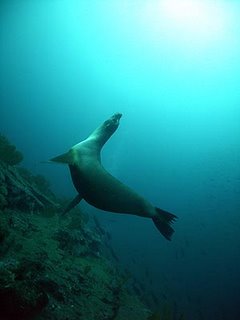
We’re soon rewarded for our bravery: playful sea-lions swim by and I actually manage to keep one’s attention for more than a second by performing some acrobatics too, which, though they must appear as slow-motion clumsy turns to a sea-lion, quickly have me sucking hard on my regulator.

 Sea-lion
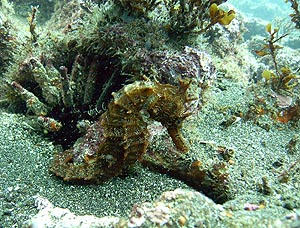
Still recovering my breath, I then turn my camera to some much calmer creatures: three pretty large seahorses, one of them clearly pregnant.

 Seahorse
Two hours after the first dive we’re back again. This time I also get to see several stingrays, a sea-turtle, a pair of small penguins passing by just above me before plunging down in hunt-mode and a flightless cormorant torpedoing by, chasing some unidentified small fish.

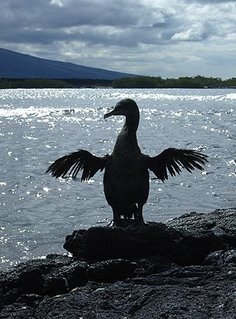
Afternoon walk-about at Punta Espinosa on Fernandina island. The place is crawling with marine iguanas, huddling together by the dozens, in harems jealously guarded by head-shaking salt-spitting males. Flightless cormorants are drying their useless wings.

 Flightless cormorant
18:00, we're sailing over the equator as the sun sets and the moon rises above the volcanoes. Another world indeed.

Sunday, December 3, 2006

Genovesa

We start the day with an early dive, rolling over into a choppy sea at 7:02. It doesn’t take long before a sea-lion joins us, showing off with some incredible underwater acrobatics. Shortly thereafter a hammerhead shark cruises by nonchalantly. In less than 20m of water! They’re not usually seen that shallow, at least not in other parts of the world. And that’s just for starters. As I turn around, an eagle ray flies by down below and a golden cow-nose ray hurries past towards... -I can hardly believe my eyes- a whole school of at least fifty golden cow-nose rays approaching from the opposite direction. And all that before breakfast!


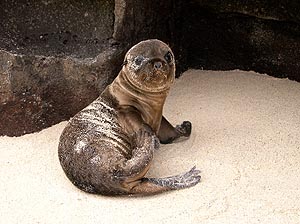
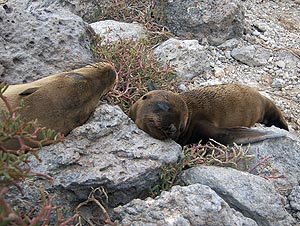
After a fortifying breakfast, Victor takes us for a land tour on Genovesa. We land on a small beach amid a sea-lion family with several cute puppies. Swallow-tail gulls are nesting right beside the path. These are the only gulls in the world that hunt at night. They share the island with masked boobies, red-footed boobies, frigate birds, Galapagos doves and herons. Most of them within touch distance, unafraid of man.

 Sea-lion puppy
After an amazing first dive, the second dive, at 15:05, in Darwin’s bay, is rather boring, with nothing worth mentioning. But then, with a visibility of about 5m, it’s hard to see much.

Saturday, December 2, 2006

M/Y Reina Silvia

At 7:30 I’m transferred to the airport by pick-up, mini-ferry and bus. Pausing along the way for a quick look down one of the pretty deep Gemelos sinkholes. The plane bringing in the other guests is late, but Victor, the main guide, looses no time rounding up everybody and organizing the move to Baltra’s harbor. There, the Gobierno Provincial De Galapagos lets us through without a word and we jump onboard a zodiac for the short ride to the M/Y Reina Silvia, our live-aboard for the next two weeks. We are fifteen tourists on this trip: nine German, one Polish and four Swiss divers, besides yours truly. To take care we get around, get fed, get to see a lot without getting lost above or under water and return happy are ten crew members: captain, first & second mate, cook & assistant, waiter/barman, engineer & assistant, deck-hand and two guides.


Being alone, I get to share a compact cabin with Piotr, a sympathetic Polish guy, who’s also appointed as my dive buddy on this trip.

After a three-course lunch, we’re thoroughly briefed about everything, prepare our gear, suit up and step into the 24°C water directly from the stern of the ship, by now anchored between the two small Plaza islands, on Santa Cruz’s east coast. Just for a short check dive, to get wet and make sure everything is working and we’re properly weighted. In my case that means 6kg of lead, in addition to my 4kg stainless-steel backplate! But then, I’m wearing a very buoyant double 7mm wetsuit.

 M/Y Reina Silvia at Plazas
We dive along a shallow coastal edge with sandy bottom. Viz is poor, about 10m. There’re some fish around, but nothing too interesting except for two turtles and a stingray. The sea-lions all seem to be sleeping on shore.

 Sea-lion puppy with its mommy
Shortly after the dive we do a quick walk-about on Plaza sur, the same place I visited two days ago. So I get to see the sea-lions again anyway :o)

Thursday, November 30, 2006

Plaza sur

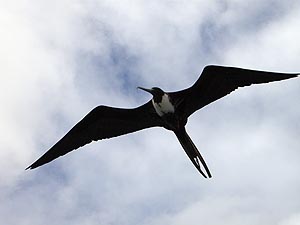
Today I joined a tour to Islas Plaza (63$ incl.lunch). More specifically to the southern one of the two islands. Together with sixteen other tourists and two guides, we first drove for almost an hour across Santa Cruz, passing through several vegetation zones, then boarded the Santa Fe II, a small boat, for the cross-over to Plaza sur, a 90' sail. Along the way, frigates suddenly start flying close besides the boat. The reason's soon clear: at the stern, the cook is cleaning some fish for lunch.

 Frigate
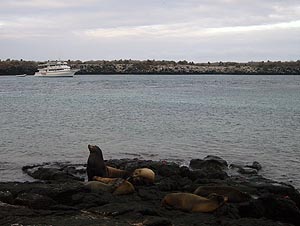
As we approach our landing place, we are greeted by barking Galapagos sea-lions. Dominant males each cruising their stretch of shore, keeping an eye on their harem. Females sunbathing among the big rocks, feeding their young. Puppies waiting for their mommy to return. Plaza sur is indeed home to a whole colony of sea-lions. And I can get real close to some.

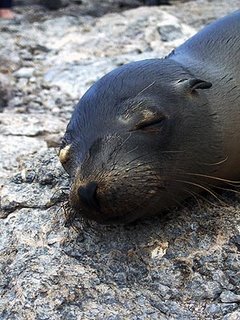
 Sea-lion
Besides these, on the surface, very lazy animals, there're also plenty of land & marine iguanas and several kinds of sea-gulls nesting on the steep cliff-side of the island.

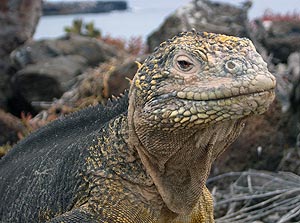
 Land iguana
Note that day-trips like this one are not the best way to see the Galapagos. Unless you don't mind spending most of your precious time in transportation to & from the various islands. But, if like me you've got a few days to acclimatize before the real show, then of course it's an option.

Wednesday, November 29, 2006

Santa Cruz: Tortuga bay

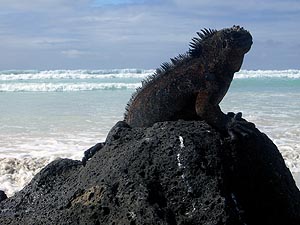
It's a 45' hot walk from the hotel to Tortuga bay, along a paved path cutting through dense scrubs and cactus trees. There's a great beach there with some surf. As I approach some black lava rocks, my eyes suddenly focus on something that moved. And it's not alone. Perfectly blending in with the rocks are at least a dozen marine iguanas, absorbing the sun's heat. I'd say the bigger ones are about 75cm.

 Marine iguana
Later on, walking along the beach, I notice more of them lazing in the sand. 15' later I come to a protected lagoon, where it's possible to swim around without being pulled down by the dangerous under-tow. The sun's burning by now. Good thing I put on some sunscreen and brought a bottle of water.

Tuesday, November 28, 2006

Santa Cruz: Puerto Ayora

Sea level. Plenty of oxygen in the air. And with a temperature of about 25°C, it's a nice bit warmer too. To get down here from Quito took me almost 7 hours by SUV, plane, bus, mini-ferry, bus and taxi. I'm not sure they knew I was coming at Hotel Silberstein, but I got a room anyway. From the hotel it's only a short walk to the Charles Darwin station, where I saw some pretty ugly giant tortoises and some very cool golden land iguanas, frigate birds gliding in the sky high above and pelicans flying by just above the cactusses.

The cost of living seems to be surprisingly low here. For only 3$ I had an almuerzo in "Rincon del Alma", a small family run place. Nothing fancy, just honest home-made filling food for hungry travelers. And pretty good value, considering I got a glass of almond milk, a bean-potato-cheese soup, rice with fried platane and meat stew and a flan as desert. 1/2l of water costs 35cents. 1/2l Gatorade 1$. Internet 2$/hr. Ecuador uses US dollars as currency.

Puerto Ayora is the main town on Santa Cruz, the second largest island of the Galapagos.

Monday, November 27, 2006

Quito

After a 28 hour journey by car, 2 trains, 2 planes and SUV I find myself in Quito, capital of Ecuador, a small country on the north-west coast of South-America. Located on the eastern slopes of the Pichincha, a 4794m high active strato-volcano in the Andes mountains, Quito, with an elevation of 2808m, is the second highest city on this planet. (Tip: To avoid altitude sickness, it's recommended to drink a lot.)


I arrived here yesterday evening, the plane litterally landing in the middle of the city, narrowly streched out over 50km between the mountain flanks.

I'm only here in transit though, a short stop-over before continuing my journey tomorrow morning, to the Enchanted Islands...

Curious about what a guy like me does when having a resting day? At 6:30 I enjoyed a nice buffet style breakfast, while the clouds drifted over the city and planes started coming in. At 8:30, in order to loosen up my travel-cramped muscles, I did 50' of fitness in the hotel's gym, followed by a warm relaxing bath and cooling rest. Then, at 10:30, to get at least a sense of the city and its people, I chartered a taxi for a private city tour. Pepe, the cab-driver, driving me by the most interesting places while giving me some background info every now and then. En Español. Two hours, 25$. That's about as much culture as I can take in a jet-lagged day :o) Back at Hotel Quito, I then had a decent, though at 15$ rather pricey, buffet style lunch. Followed by some blogging (3$/hr). At 16:00 I got a 50' massage to relax some more. Having been warned several times to be very careful outside, and there not really being anything nearby that looks like a nice place to eat, I decide to call room-service around 19:00... Bad choice. Must have been the worst burger in my life :o( Wake-up call tomorrow is at 5:30, so a night in town is out of the question. Not really a problem as there's a 6 hour time difference with Europe, and at 20:00 I'm about falling over.

Monday, May 15, 2006

Bangkok: Last day

I repacked once again. This time resulting in an 11kg city backpack and a 28kg gear bag. Luckily they didn't charge me for the overweight. The taxi ride to the airport, arranged through the guesthouse for 290 THB, took 45' using the normal road (not the expressway). There's a 500 THB departure tax. The duty free hall is fairly big but rather uninteresting.

Sunday, May 14, 2006

Bangkok: Chatuchak weekend market

From the Khao San road area the easiest way to get to Chatuchak is by taxi (80 THB). Once there you can wander around the vast covered market area for hours. They sell all kinds of things here: clothes, household stuff, silverware, amulets, souvenirs, furniture, ... and of course food. Quite an experience. A must see really.

For a totally different shopping experience you can head to one of the big up-scale shopping centers like Siam Center/Paragon or the more popular MBK complex. In the former I had a nice cafe latte and muffin in Starbucks, for 135 THB. And in the latter I enjoyed some great Japanese food (sushi, tempura & soup) and sake, for 420 THB.

It's quite amazing actually how fast you can move from one price range to another, eating for 30 THB, then dining for 600 THB, just by walking to another street. And as you can imagine, I didn't even come near the really expensive places...

Saturday, May 13, 2006

from Hua Hin to Bangkok

There's a 2nd class AC bus leaving Hua Hin for Bangkok every half hour. The ride takes about 4 hours and costs 160 THB (including a small bottle of water). From Bangkok's southern bus station it's a 15' taxi ride to Khao San road (55 THB by meter, 200 THB if you listen to the touts).

Before leaving Bangkok, I'd left my heavy dive gear at New Siam guest house for 15 THB/day, allowing me to travel light. A real luxury! At New Siam, prices vary from 240 THB for a single fan room with common cold water shower to 550 THB for a double AC room with private hot water shower. Breakfasts here are decent.

For nice food I can recommend the Baan Sabai hotel & restaurant. It still has some colonial atmosphere and a quiet terrace.

Wednesday, May 10, 2006

Hua Hin

Hua Hin is a modern coastal city, only 2 hours south of Petchaburi (30 THB by 3rd class fan bus), fully geared towards tourism, both Thai and foreign. Its long beach is completely lined up with private properties, towering condos and tourist class resorts. While this may not sound too great, in a way it's actually nicer than over-built and over-crowded Koh Tao. At least if you find the right place.


Baan Talay Dao resort is a fairly new and relatively small place with accomodations varying from comfortable studios to deluxe suites, just a couple of kilometers south of town. I stayed here three nights, enjoying buffet breakfasts, walks along the beach, the refreshing swimming pool & jacuzzi, the peaceful lush garden setting and dinners overlooking the beach... all that for about 80 USD/day, all included. The restaurant serves delicious Thai food and pretty decent steaks.

Monday, May 8, 2006

Petchaburi

Just a short 3rd class train ride (3h45, 138 THB) from Bangkok lies Petchaburi, a town off the main tourist maps, where people still smile at you and offer help without being asked. I stayed in a no-name Chinese hotel, in a basic fan room with common cold water bathroom for 200 THB.


The town is full of wats (= temples), one of them on top of a small hill, where monkeys rule without mercy. Vendors actually sell corn and bananas to feed them. And they know it. It's strongly advised NOT to bring anything in a plastic bag unless you want to get rid of it. I personally witnessed several take-away strategies.

Strategy #1: A medium sized monkey nonchalantly strolls towards you, looking the other way, as if interested in something in the trees. But as it passes by your side, it suddenly turns around, snatches your bag away and leaps off to examine its catch.

Strategy #2: An alpha monkey comes towards you without a trace of doubt, its purpose clear: your plastic bag. In this case I was holding the bag and cleared it away from its grabbing hands. Having missed the bag, it then jumped straight onto me to get another go, baring its teeth to warn me not to fool around. At which point I conceded and it ran away with its booty: a couple of sweet cakes and a botlle of water - which it expertly opened to have a gulp after having gorged on the cakes.

Strategy #3: When a tourist is stupid enough to buy monkey food, why wait till he/she actually gives it to you? As the vendor hands over a couple of bags of corn to an unsuspecting (Thai) tourist, a big female monkey jumps in and runs off with both bags crammed in her arms.

Sunday, May 7, 2006

Bangkok: Wat Pho

Dressed in shorts I wasn't allowed in the Royal Palace, but I could enter Wat Pho (entrance fee: 50 THB), the temple of the oversized golden reclining Buddha. There're quite a few other temples and stupas on the grounds and several stone statues of fierce looking guards.

Friday, May 5, 2006

Bangkok: Khao San road

Khao San road & surrounding streets truly are a phenomenon. So much so that they've become a tourist attraction. It's much more alive than Charoen Krung road where I stayed upon arrival. Not only because of all the backpackers from all over the world, but also because you can easily get away from it all by submerging yourself into the bustling city life just a couple of streets away. Off the main tourist streets, you can get a street side meal for 20-30 THB. A fraction of the price you pay in the places catering to tourists.

Wednesday, May 3, 2006

from Koh Tao to Bangkok

After 3 days of doing nothing but sleep, eat, read and walk along the beach at sunset I finally got myself together to leave the island and bought a joint ticket (ferry-bus-train, 2nd class AC upper bunk) for 1080 THB.

The Songserm ferry is pretty terrible, its aircon being set to deep-freeze, chasing everybody up to the windy roof for the 3 hour crossing. From Chumporn pier to Chumporn train station it's only a short 10' bus ride. Dinner in the nearest eatery, as I really don't feel like lugging my 40kg of gear around town. The express train leaves on time, and I'm actually able to get some sleep before arriving in Bangkok around 7:15 (only 45' late). From the station its a 50 THB taxi ride to Khao San road.

Shambara guesthouse is full, so I head over to another backpacker street nearby, and end up in the Bella Bella guesthouse. Basic twin room with fan and common cold water bathroom, 270 THB. I'm totally drenched in sweat by the time I've climbed the stairs to the fifth floor. But, it's quiet up there, and there's even a view of Bangkok's rooftops. Eggs, toasts and coffee breakfast costs about 70 THB. Internet access is cheap at 30 THB / hour and burning a CD only costs 100 THB.

Saturday, April 29, 2006

Koh Tao: Jamahkiri health spa

Just to sweat a little bit more I went to a herbal steam sauna, then, in order to cool down again, I got smeared in with aloe vera gel and wrapped up in a sheet to relax, followed by a face cleaning treatment and a jasmin oil massage. All in all 2h30 of special attention, for 1750 THB at the Jamahkiri spa & resort. Because I'm worth it :o)

Friday, April 28, 2006

Koh Tao: Like a flying fish

Shortly after I arrived on Koh Tao, an ad in one of the restaurants caught my eye. It was about a flying boat. The place being close to where I stayed I went to check it out and met Rafael, Israelian, owner of the shop, pilot and instructor, who was happy to answer all my questions. So now, three weeks later, after having done all my deep wreck diving and Bjarne's OW course, I showed up again and made arrangements for a little trial flight (about half an hour for 2800 THB only). As passenger of course.


Rafael set-up and prepared the FIB (Flying Inflatable Boat) did his pre-flight checks, got the boat pulled into the water and off we went!

After taxiing for almost 10' to get the right wind we effortlessly took off, rising higher and higher above the sea. Whow! Then we skirted the island's coastline for about 25' before smoothly landing back in Mae Haad bay.


The FIB only takes two people (incl. the pilot), securely strapped up, with a visored helmet and earphones for in-flight communication. Not that I said much, as I was just too enthralled enjoying the view.


Yeah, I could imagine myself learning to fly one of these. Just for the fun of it. Apparently it only takes about two weeks to learn (consisting of theory, about 15 hours of duo flights, 3 hours of solo flights & exam - all that for about 2000 USD).

I was not allowed to bring my own camera, to avoid it flying off on its own into the rear propeller. A precaution I accepted reluctantly. Unfortunately the FIB's wing-fixed camera didn't do its job properly, so I've got no in-flight pictures :o(

Thursday, April 27, 2006

Gulf of Thailand, April 2006

Imagine a deep blue sea and a clear blue sky, all around you, as far as the eye can see...


Standing on the M/V Trident's upper deck, that's exactly the view I enjoy right now. Slowly sipping my early morning coffee. Waiting for the sun to rise just a little bit more, so as to have more light penetrating the water.

Everything's ready, I just need to gear up and splash in for some deep wreck diving!

trip report
travel blog

Thailand - info sheet

VisumBelgian citizens automatically get a four weeks visum upon entry. For longer stays a visum must be requested beforehand. In Copenhagen, a two months visum can be obtained from the Thai embassy within a week. Besides your passport you must bring two pictures, a copy of your Danish residence permit & travel documents, fill in an application, and pay 175 DKK.
TimeBangkok time = Copenhagen summer time + 5h
WeatherAir temperature's around 35°C, very humid with occasional tropical showers. Water temperature's a balmy 29°C.
Currency1 Euro = 46 THB
1 USD = 37 THB
LanguageEnglish is barely spoken by some.