Thursday, December 14, 2006

Isabela: Cabo Marshall

Dive 1: Cabo Marshall, 6:58, 24°C water, visibility about 10m, mild current. As soon as we submerge we sight a small manta shying away in the blue. Soon followed by several big ones flying by below us.

Then, from the deep, a large school of mobulas comes straight towards me... before veering off to my right as they continue their climb. What a fantastic sight! I can hardly believe my eyes.

 Mobulas
Later, as I drift away from my team, peering into the blue, I sight some more mobulas, apparently flying around in a circle, being joined by more and more of their kind, slowly forming a girating swarm of congragating mobulas, dancing in the sun's rays. Whow!

 Mobulas
In just this one dive, I've seen more mantas and mobulas than in all my -over 1400- previous dives put together.

 Manta
Dive 2: Same place, 10:23, same conditions. Not a single manta or mobula to be seen. A couple of hammerhead sharks do come by to see us off. As well as a white-tip reef shark.

 White-tip reef shark

Wednesday, December 13, 2006

Isabela: Punta Vicente roca

After Wolf & Darwin's tropical conditions, the 20°C water at punta Vicente roca feels... cold. But the sea-lions and flightless cormorants don't seem to mind. Also to be seen here are turtles, octopus, seahorses and shrimp colonies.

Tuesday, December 12, 2006

Darwin

Another three hammerhead dives at Darwin's arch. During the second dive, I actually get to glimpse a huge school, there must be hundreds of them, way out in the blue, barely visible, but whow, what a sensation!

Hovering in the blue, one moment I'm surrounded by thousands of small fish and a gang of jacks, then, suddenly, in a split-second, they're all gone. Below, a dolphin shoots by. Clearly in hunting-mode. Then, out of nowhere, they're all back, as if nothing had happened. Incredible.

As we finish our third dive, we end up beside a school of steel pompanos, hanging around just below the surface.

 Steel pompanos

Monday, December 11, 2006

Darwin

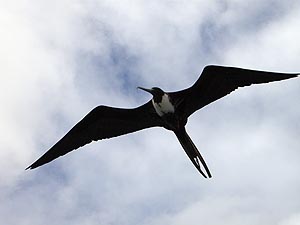
Darwin island. Sunrise. Thousands of boobies and frigates are in the air, circling above their volcanic layer-cake island, rejoycing in a new day. The imposing steep cliffs prohibit any landings. I can hardly wait to get going and jump in.

 Darwin island & arch
Dive 1: The arch, 7:06, calm sea, 26°C water, visibility a good 15m, mild current. For some reason we're almost always diving in one big group of 17, despite being divided in three teams... creating a -for sharks- unpenetrable wall of bubbles when all of us are hanging onto the rocks. Only when my team finally heads off and ends up on top of a sand patch do we get to see some action: hammerheads coming in for some servicing by eager cleaner fish.

 Hammerhead shark
Dive 2: The arch, 10:55, strong current & surge. Same scenario. Nothing to be seen until we split into smaller groups. Only then do they appear out of the blue, in small packs. And this time I get my -it's now or never- chance: one of them turns and slowly swims straight towards me, I take a deep breath, it comes closer still, I hold my breath to avoid freaking it with bubbles and point my camera, when it fills my frame I shoot, it veers away, I shoot again, it's gone. Later on we also glimpse a dolphin diving down and some jacks streaming by.

 Hammerhead shark

 Hammerhead shark

Dive 3: The arch, visibility has dropped to 10m. Again, the best action is above the cleaning-station sand patch. Spread out over several meters we get to see hammerheads all around us and near enough to be real exciting. And I even get to see my first Galapagos shark.

 Hammerhead sharks

Sunday, December 10, 2006

Wolf

We sailed the whole night and when I wake up we're just anchoring beside steep cliffed Wolf island. The air is swarming with sea birds. There's no way to set foot on land here, instead we've got three dives on the program.

Dive 1: Falling rocks, 7:02, 26°C water allowing me to dive without my restraining jacket, nice visibility of about 15m but not much sunlight, only a slight current. There's nothing to be seen at first, then slowly they start appearing out of the blue: hammerhead sharks, plenty of them. Not very close but everywhere. When Rafael, my team's guide, suddenly starts finning into the blue I follow in his wake, and am rewarded with the sight of a whole school of hammerheads slowly passing by. During the rest of the dive I spot at least ten eagle-rays, a sea-lion, a sea-turtle and a lone white-tip reef shark. This is definitely more like it!

Dive 2: Shark bay, 10:50, same conditions. Several small schools of hammerheads cruising by in the blue, always keeping their distance. Powerful as they are, they are rather shy and don't like our noisy bubbles at all. But a few do come a bit closer to inspect the commotion. And I finally do get my chance to take one shot. (Note the love bites on her back.)

 Hammerhead shark
Dive 3: Shark bay, 14:57, same decent visibility, no current. They're still there. Above. At the side. Below. Unfortunately out of camera reach. At the end of the dive, during our safety stop, a lone mobula passes by. The first one of this trip.

Saturday, December 9, 2006

North-Seymour

I decide to have a dry day, skipping the early morning dive, after which we set sail for Wolf & Darwin. The islands I've been waiting for since this trip began. Tomorrow we'll be there...

Friday, December 8, 2006

Española: Gardner seamount

We start the day with a great dive at Gardner sea-mount: several marble stingrays hiding in the sand or under overhangs, eagle-rays in the blue and a small school of about twenty golden cow-nose rays flying by! Not to mention two huge jackfish.

Not so great is that I've lost my group... they just disappeared into the blue and did not come back to the reef as agreed in the pre-dive briefing. So I surface alone, amid 2m swells. No land nor zodiac in sight. Before deploying my SMB I blow my tank-pressure-powered horn. While pretty shrill it sounds rather meek in the middle of the ocean. No worries though, a bit later a zodiac appears. And moves on without picking me up! Because I belong to the white team, and it's the yellow team's zodiac... I'm still bobbing there in disbelief when the green team's zodiac passes by and just leaves me there too. Incredible. They do return however once they've picked up their team members and remain by my side until my own zodiac finally arrives.

The second dive, at the same place, is even better than the first one. First a squadron of six eagle-rays passes by within shooting range. Later followed by another one of five. And I get to see some more marble rays and sea turtles too.

 Eagle-rays
Long sunny walk at punta Suarez, where we get to see the usual inhabitants: sea-lions and marine iguanas. The iguanas have red flanks here, due to their diet consisting primarily of red algaes. We also get pretty close to masked and blue-footed boobies. The latter have an elaborate courtship ritual that we're luckiy enough to witness: the male slowly lifts one foot after the other, in a funny dance, the female -if interested- mimicks his steps, he then raises his beak straight up in the air, as well as his tail and wings, to see if she really means it, if she does she'll mimick him again. After repeating this a number of times, confirming their partnership, they'll then get a bit more romantic by touching beaks and picking up twigs. Pretty cute.

Blue-footed boobies
Further on, we also sight a few waved albatros, the last ones of this breeding season, as most have already taken off.

Thursday, December 7, 2006

Floreana: Enderby & Champion

Early dive at Enderby followed by a land tour at punta Cormoran. There's a shallow lagoon there, with about 30 flamingos. We are lucky enough to witness a courtship parade by a bunch of stiff-walking head-turning cackling males. A rather funny spectacle, that no female seems to be interested in. In a nearby bay, at least half a dozen turtles are hanging around, resting, waiting for nightfall to crawl up the beach and start their labour. December and January are the egg laying months here for sea turtles.

 Flamingos
Second dive, a little after two, is at Champion. The sun's out. The water's a nice 26°C. Visibility about 10m. Turtles, some schooling fish, a bunch of white-tips, a dark marble stingray and a playful sea-lion at the end. Not bad.

Wednesday, December 6, 2006

Santa Cruz: Gordon's rock

First action dive of the trip, starting with a rough entry & speedy descent. A lone hammerhead shark in the blue keeps a safe distance. A handful of white-tip reef sharks swim by below. I take my first shot at another hammerhead coming a bit closer. But alas not close enough. A sea-turtle wanders by. Followed by a sea-lion speeding towards who-knows-what. Probably just showing off again.

I decide to skip the second dive, held at the same place, to get a bit of a rest. There're plenty more diving days ahead.

Tuesday, December 5, 2006

Santiago: Cousin's rock

Busy day. Starting with an early morning wet-feet landing on a black-lava-sand beach. Home of -you'll never guess- marine iguanas and Galapagos sea-lions. The more special thing about this island however is that it also houses the smaller nocturnal fur sea-lions, which during the day time usually hide in crevasses & cliff-side holes.

Pre- & post-lunch dives are done at Cousin's rock. The main thing here being a large & dense school of striped salemas. A white-tip reef shark cruising by adding a bit of spice.

Just before sunset we go for a little climb on Bartolome island to enjoy the view of the surrounding volcanic landscape.

Monday, December 4, 2006

Isabela: Tagus cove

After breakfast we suit up and hop in the zodiacs for the short ride from the ship to today’s prime dive spot: Tagus cove. It’s 8:04 when we roll into the instant-wake-up 19°C cold water. Luckily my double 7mm wetsuit does keep me cozy if not comfy.

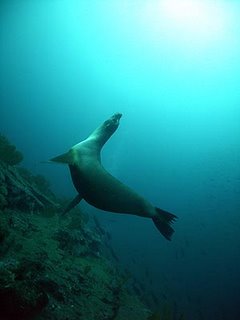
We’re soon rewarded for our bravery: playful sea-lions swim by and I actually manage to keep one’s attention for more than a second by performing some acrobatics too, which, though they must appear as slow-motion clumsy turns to a sea-lion, quickly have me sucking hard on my regulator.

 Sea-lion
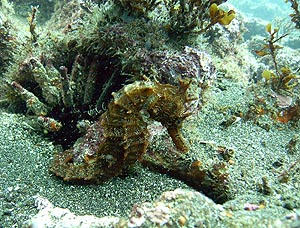
Still recovering my breath, I then turn my camera to some much calmer creatures: three pretty large seahorses, one of them clearly pregnant.

 Seahorse
Two hours after the first dive we’re back again. This time I also get to see several stingrays, a sea-turtle, a pair of small penguins passing by just above me before plunging down in hunt-mode and a flightless cormorant torpedoing by, chasing some unidentified small fish.

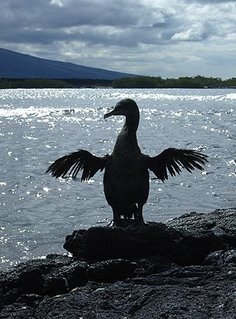
Afternoon walk-about at Punta Espinosa on Fernandina island. The place is crawling with marine iguanas, huddling together by the dozens, in harems jealously guarded by head-shaking salt-spitting males. Flightless cormorants are drying their useless wings.

 Flightless cormorant
18:00, we're sailing over the equator as the sun sets and the moon rises above the volcanoes. Another world indeed.

Sunday, December 3, 2006

Genovesa

We start the day with an early dive, rolling over into a choppy sea at 7:02. It doesn’t take long before a sea-lion joins us, showing off with some incredible underwater acrobatics. Shortly thereafter a hammerhead shark cruises by nonchalantly. In less than 20m of water! They’re not usually seen that shallow, at least not in other parts of the world. And that’s just for starters. As I turn around, an eagle ray flies by down below and a golden cow-nose ray hurries past towards... -I can hardly believe my eyes- a whole school of at least fifty golden cow-nose rays approaching from the opposite direction. And all that before breakfast!


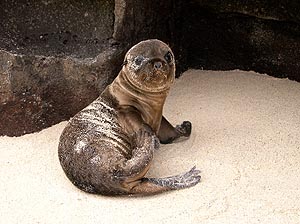
After a fortifying breakfast, Victor takes us for a land tour on Genovesa. We land on a small beach amid a sea-lion family with several cute puppies. Swallow-tail gulls are nesting right beside the path. These are the only gulls in the world that hunt at night. They share the island with masked boobies, red-footed boobies, frigate birds, Galapagos doves and herons. Most of them within touch distance, unafraid of man.

 Sea-lion puppy
After an amazing first dive, the second dive, at 15:05, in Darwin’s bay, is rather boring, with nothing worth mentioning. But then, with a visibility of about 5m, it’s hard to see much.

Saturday, December 2, 2006

M/Y Reina Silvia

At 7:30 I’m transferred to the airport by pick-up, mini-ferry and bus. Pausing along the way for a quick look down one of the pretty deep Gemelos sinkholes. The plane bringing in the other guests is late, but Victor, the main guide, looses no time rounding up everybody and organizing the move to Baltra’s harbor. There, the Gobierno Provincial De Galapagos lets us through without a word and we jump onboard a zodiac for the short ride to the M/Y Reina Silvia, our live-aboard for the next two weeks. We are fifteen tourists on this trip: nine German, one Polish and four Swiss divers, besides yours truly. To take care we get around, get fed, get to see a lot without getting lost above or under water and return happy are ten crew members: captain, first & second mate, cook & assistant, waiter/barman, engineer & assistant, deck-hand and two guides.


Being alone, I get to share a compact cabin with Piotr, a sympathetic Polish guy, who’s also appointed as my dive buddy on this trip.

After a three-course lunch, we’re thoroughly briefed about everything, prepare our gear, suit up and step into the 24°C water directly from the stern of the ship, by now anchored between the two small Plaza islands, on Santa Cruz’s east coast. Just for a short check dive, to get wet and make sure everything is working and we’re properly weighted. In my case that means 6kg of lead, in addition to my 4kg stainless-steel backplate! But then, I’m wearing a very buoyant double 7mm wetsuit.
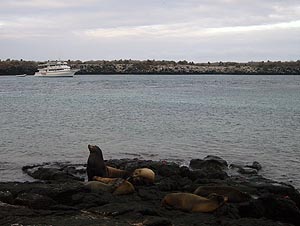
 M/Y Reina Silvia at Plazas
We dive along a shallow coastal edge with sandy bottom. Viz is poor, about 10m. There’re some fish around, but nothing too interesting except for two turtles and a stingray. The sea-lions all seem to be sleeping on shore.
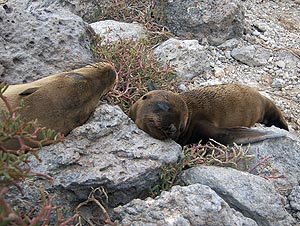
 Sea-lion puppy with its mommy
Shortly after the dive we do a quick walk-about on Plaza sur, the same place I visited two days ago. So I get to see the sea-lions again anyway :o)

Thursday, November 30, 2006

Plaza sur

Today I joined a tour to Islas Plaza (63$ incl.lunch). More specifically to the southern one of the two islands. Together with sixteen other tourists and two guides, we first drove for almost an hour across Santa Cruz, passing through several vegetation zones, then boarded the Santa Fe II, a small boat, for the cross-over to Plaza sur, a 90' sail. Along the way, frigates suddenly start flying close besides the boat. The reason's soon clear: at the stern, the cook is cleaning some fish for lunch.

 Frigate
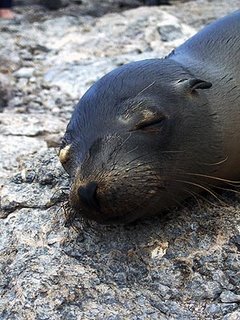
As we approach our landing place, we are greeted by barking Galapagos sea-lions. Dominant males each cruising their stretch of shore, keeping an eye on their harem. Females sunbathing among the big rocks, feeding their young. Puppies waiting for their mommy to return. Plaza sur is indeed home to a whole colony of sea-lions. And I can get real close to some.

 Sea-lion
Besides these, on the surface, very lazy animals, there're also plenty of land & marine iguanas and several kinds of sea-gulls nesting on the steep cliff-side of the island.

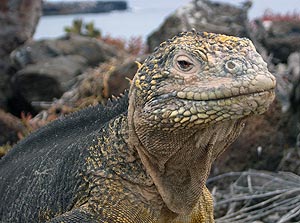
 Land iguana
Note that day-trips like this one are not the best way to see the Galapagos. Unless you don't mind spending most of your precious time in transportation to & from the various islands. But, if like me you've got a few days to acclimatize before the real show, then of course it's an option.

Wednesday, November 29, 2006

Santa Cruz: Tortuga bay

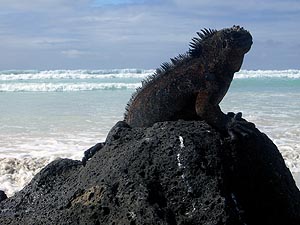
It's a 45' hot walk from the hotel to Tortuga bay, along a paved path cutting through dense scrubs and cactus trees. There's a great beach there with some surf. As I approach some black lava rocks, my eyes suddenly focus on something that moved. And it's not alone. Perfectly blending in with the rocks are at least a dozen marine iguanas, absorbing the sun's heat. I'd say the bigger ones are about 75cm.

 Marine iguana
Later on, walking along the beach, I notice more of them lazing in the sand. 15' later I come to a protected lagoon, where it's possible to swim around without being pulled down by the dangerous under-tow. The sun's burning by now. Good thing I put on some sunscreen and brought a bottle of water.

Tuesday, November 28, 2006

Santa Cruz: Puerto Ayora

Sea level. Plenty of oxygen in the air. And with a temperature of about 25°C, it's a nice bit warmer too. To get down here from Quito took me almost 7 hours by SUV, plane, bus, mini-ferry, bus and taxi. I'm not sure they knew I was coming at Hotel Silberstein, but I got a room anyway. From the hotel it's only a short walk to the Charles Darwin station, where I saw some pretty ugly giant tortoises and some very cool golden land iguanas, frigate birds gliding in the sky high above and pelicans flying by just above the cactusses.

The cost of living seems to be surprisingly low here. For only 3$ I had an almuerzo in "Rincon del Alma", a small family run place. Nothing fancy, just honest home-made filling food for hungry travelers. And pretty good value, considering I got a glass of almond milk, a bean-potato-cheese soup, rice with fried platane and meat stew and a flan as desert. 1/2l of water costs 35cents. 1/2l Gatorade 1$. Internet 2$/hr. Ecuador uses US dollars as currency.

Puerto Ayora is the main town on Santa Cruz, the second largest island of the Galapagos.

Monday, November 27, 2006

Quito

After a 28 hour journey by car, 2 trains, 2 planes and SUV I find myself in Quito, capital of Ecuador, a small country on the north-west coast of South-America. Located on the eastern slopes of the Pichincha, a 4794m high active strato-volcano in the Andes mountains, Quito, with an elevation of 2808m, is the second highest city on this planet. (Tip: To avoid altitude sickness, it's recommended to drink a lot.)


I arrived here yesterday evening, the plane litterally landing in the middle of the city, narrowly streched out over 50km between the mountain flanks.

I'm only here in transit though, a short stop-over before continuing my journey tomorrow morning, to the Enchanted Islands...

Curious about what a guy like me does when having a resting day? At 6:30 I enjoyed a nice buffet style breakfast, while the clouds drifted over the city and planes started coming in. At 8:30, in order to loosen up my travel-cramped muscles, I did 50' of fitness in the hotel's gym, followed by a warm relaxing bath and cooling rest. Then, at 10:30, to get at least a sense of the city and its people, I chartered a taxi for a private city tour. Pepe, the cab-driver, driving me by the most interesting places while giving me some background info every now and then. En Español. Two hours, 25$. That's about as much culture as I can take in a jet-lagged day :o) Back at Hotel Quito, I then had a decent, though at 15$ rather pricey, buffet style lunch. Followed by some blogging (3$/hr). At 16:00 I got a 50' massage to relax some more. Having been warned several times to be very careful outside, and there not really being anything nearby that looks like a nice place to eat, I decide to call room-service around 19:00... Bad choice. Must have been the worst burger in my life :o( Wake-up call tomorrow is at 5:30, so a night in town is out of the question. Not really a problem as there's a 6 hour time difference with Europe, and at 20:00 I'm about falling over.

Monday, May 15, 2006

Bangkok: Last day

I repacked once again. This time resulting in an 11kg city backpack and a 28kg gear bag. Luckily they didn't charge me for the overweight. The taxi ride to the airport, arranged through the guesthouse for 290 THB, took 45' using the normal road (not the expressway). There's a 500 THB departure tax. The duty free hall is fairly big but rather uninteresting.

Sunday, May 14, 2006

Bangkok: Chatuchak weekend market

From the Khao San road area the easiest way to get to Chatuchak is by taxi (80 THB). Once there you can wander around the vast covered market area for hours. They sell all kinds of things here: clothes, household stuff, silverware, amulets, souvenirs, furniture, ... and of course food. Quite an experience. A must see really.

For a totally different shopping experience you can head to one of the big up-scale shopping centers like Siam Center/Paragon or the more popular MBK complex. In the former I had a nice cafe latte and muffin in Starbucks, for 135 THB. And in the latter I enjoyed some great Japanese food (sushi, tempura & soup) and sake, for 420 THB.

It's quite amazing actually how fast you can move from one price range to another, eating for 30 THB, then dining for 600 THB, just by walking to another street. And as you can imagine, I didn't even come near the really expensive places...

Saturday, May 13, 2006

from Hua Hin to Bangkok

There's a 2nd class AC bus leaving Hua Hin for Bangkok every half hour. The ride takes about 4 hours and costs 160 THB (including a small bottle of water). From Bangkok's southern bus station it's a 15' taxi ride to Khao San road (55 THB by meter, 200 THB if you listen to the touts).

Before leaving Bangkok, I'd left my heavy dive gear at New Siam guest house for 15 THB/day, allowing me to travel light. A real luxury! At New Siam, prices vary from 240 THB for a single fan room with common cold water shower to 550 THB for a double AC room with private hot water shower. Breakfasts here are decent.

For nice food I can recommend the Baan Sabai hotel & restaurant. It still has some colonial atmosphere and a quiet terrace.