It all started a long time ago with a bowl of soup. Not just any soup of course, but a two thousand year old Chinese delicacy, served at special occasions like wedding feasts, birthday parties and festive banquets. Not because of its exquisite flavor or exceptional nutritional value, but as a symbol of wealth and prosperity. In other words, a status symbol soup, where the size of its tasteless but pricey main ingredient matters a lot indeed. For the bigger it is, the more money the host must have dished out. You see, shark fin soup is all about prestige. Not about good taste.
While demand for this cartilaginous broth supposedly has dropped in Hong Kong, until a few years ago the main trade market in shark fins, it is now exploding in economically booming China. Since time immemorial a very popular place, a lot of its new middle-class mouths are now demanding some symbolic respect in the form of a bowl of soup.
With single fins going for 100 USD or more (up to 15000 USD for whale shark fins!) and bowls of shark fin soup costing up to 200 USD in up-scale restaurants all over the world, fin business is an extremely lucrative trade, valued at a couple of billion USD. And, just as China's wealthy class, business is growing.
The demand for shark fins is already such that finning is going on everywhere. Ruthlessly. Excessively. Out of control.
• Not just in Asian waters. But in every sea and ocean on this wet planet of ours. The blue shark, whose fins are first choice according to the FAO, is the world's most abundant and heavily fished pelagic shark. Still, despite a decline in population of more than half in the North Atlantic, it is only classified as near threatened. As long as there's money to be made, mercy is not an option.
• Not just in unregulated international waters but also illegally in supposedly protected national marine parks like the Galapagos (Ecuador) and Cocos (Costa Rica), to name but just two.
• Not just by Asian fleets (from China, Taiwan, Japan, Indonesia, Singapore, Hong Kong, Malaysia, Philippines, etc), but also by European (from Spain, Norway, UK, etc) and American fleets (from Costa Rica, Ecuador, Peru, Brazil, USA, Mexico, etc) among others (from Australia, South Africa, United Arab Emirates, Fiji, etc). In short, everybody's having a feeding-frenzy in the same bowl. As long as it lasts. The EU for example supplies 27% of all fins imported into Hong Kong.
Entire fishing fleets are out there to catch any sharks they can, slice off their fins and throw the now helpless fish back into the water to drown. Brutal but efficient. Time is money. And so is storage space. At up to 700 USD/kg for the fins, it's not worth it to keep the carcasses for their low value meat.
Highest on the hit list are blue sharks, hammerheads, silky sharks and thresher sharks. But of course any other sharks will do too, whether coastal or pelagic, endangered or not. There's no discrimination in this chop-chop business.
Even worse, these I'm-just-making-a-living people don't just catch mature animals but also young ones, thus preventing already depleted populations to recover. A slow process at best, as most shark species mature late and reproduce slowly. Not surprisingly, over the last 15 years many shark populations have declined by 70 to 90%. In other words, systematic extermination. Just because some of us are having a celebration and absolutely need to impress the guests.
For some shark species the economical situation's bad enough, for them to have been officially classified as bankrupt endangered by CITES: the basking-, whale-, and great white shark for example are finning against time. In reality, all are threatened. After having survived for over 400 million years.
A fairly recent report, based on six year old data, by Imperial College London researchers, states that the number of sharks being killed to satisfy the increasing hunger for shark fin soup is three to four times higher than previously thought and that some shark species are at serious risk. If that isn't a wonderful example of British understatement I don't know what is.
According to their independent estimates of annually traded shark fins, between 26 and 73 million sharks are killed each year. A lot more than what is being reported to the FAO - who previously naively estimated that only about ten million sharks were harvested each year. But then, most fishing is unregulated, uncontrolled and unreported. So how would they know?
These new numbers are based on fins traded at Hong Kong auctions, where an estimated 50% of all the fins are sold. These numbers do not take into account all catches. Who knows how many more sharks (1) fall victim of unwanted unrecorded by-catch by fleets targeting other species, (2) are sold on black markets - dealing in endangered species among others, (3) are being killed just for sport by assholes trophy hunters collecting jaws, (4) are actually caught for their meat and consumed locally or (5) are used for natural medicines.
Which is why some conservationists claim the number of sharks slaughtered every year is more likely to be as high as 150 million.
These are of course all just numbers. Guesses that, as soon as they're published, always are rejected or discredited by some lobby organization or other. Whether because they're too low or too high.
But while they argue about estimated numbers, the actual number of living sharks is decreasing every bloody day. Everywhere, sharks are disappearing from otherwise vibrant reefs and have become a rare sight at best in many places.
So... whenever you do see a shark, please don't kill it if it's still alive and don't eat it if it's alas already dead.
Thanks, TM
Tuesday, February 27, 2007
Source material about shark finning
→ Science News, 04/11/2006: "New Estimates of the Shark-Fin Trade"
... one Hong Kong fin trader recently told [Clarke from Imperial College London]: "I think the real fin trade is three times what you estimated." ...
... A disturbing fact gleaned from the Hong Kong auctions, the researchers say, is that many of the fins being traded come from immature animals. Unlike most fish, sharks may take up to 20 years before they reproduce for the first time. Moreover, sharks bear few young at a time -in many cases only two to four- and, typically, only every few years or so. Harvesting sharks before they've reproduced limits the chance that already depleted shark populations will recover. ...
→ Imperial College London, 25/10/2006: "Sharks in danger from fashion for fin soup"
... results show that between 26 and 73 million sharks are killed each year ...
... The species most at risk of being killed for their fins include blue shark, hammerheads and silky sharks, but many other species are also used. ...
→ National Geographic, 12/10/2006: "38 Million Sharks Killed for Fins Annually, Experts Estimate"
... The shark-fin industry, concentrated in a few Asian trading centers, is secretive and wary of any attempts to regulate, or even investigate, its practices. ...
→ The Guardian, 31/08/2006: "Sharks pay high price as demand for fins soars"
... In the fish markets of Asia, the tailfin from a basking shark can fetch nearly 10000 USD ...
... Demand for the delicacy is rising fast, and at up to 100 USD a bowl, fisheries around the world are in open competition to supply more than 10000 tonnes of fins to Hong Kong, China, Taiwan, Japan and Singapore every year. ...
... According to the conservationists, finning is exacerbating a crisis in global shark populations, some of which have already plummeted by more than 90% since the advent of industrialised fishing. Records from fisheries published in 2003 revealed that numbers of thresher sharks have fallen by 75% in just 15 years through overfishing. ...
... The majority of sharks caught for their fins are the blue sharks, threshers and hammerheads of more exotic waters, but North Atlantic species, including the porbeagle, angel, shortfin mako and spiny dogfish - sold in British fish and chip shops as rock salmon - are also under threat. ...
... Spain, home to one of the largest fisheries in the world that catches 50000 tonnes of sharks per year and supplies nearly one third of all shark fins on the Hong Kong market. ...
→ The Independent, 25/06/2006: "FINS FOR SALE: Galapagos sharks are under threat due to growing demand for £100-a-bowl soup in Chinese restaurants"
... Despite bans on the trade in fins, conservationists believe that in the past five years the fins of more than 1.7 million sharks have been exported from Ecuador - and the Galapagos region accounted for more than 80 per cent of those. ...
... Leonor Stjepic of the Galapagos Conservation Trust yesterday warned that the shark populations of the islands' waters were in dramatic decline. ...
... [Finning] is wreaking havoc on the marine reserve that surrounds the Galapagos and is home to 33 shark species. Of those, the hammerhead, the blue, the thresher, the black tip, the mako and the Galapagos are being hit hardest. ...
→ United Nations, 18/05/2006: "Overfishing causes dramatic decline in stocks"
... more than 50 per cent of the highly migratory oceanic sharks ... are overexploited or depleted. ...
→ The New York Times, 05/01/2006: "Hidden Cost of Shark Fin Soup: Its Source May Vanish"
... Some sharks, like the hammerhead and the great white, have been reduced by upwards of 70 percent in the last 15 years, while others, like the silky white tip, have disappeared from the Caribbean. ...
... Fins sell for as much as 700 USD per kilogram in Asia, making big sharks worth thousands of dollars. ...
... With the waters off Asia largely depleted, fishermen are focusing on regions that still swarm with sharks, like the cold, deep waters of the Pacific from Peru north to Central America. ...
→ Natural History Museum: "Jaws: The natural history of sharks"
... All over the world, sharks are big business, and over 150 million are slaughtered each year as the demand for shark products increases: sharks are prime targets for sports anglers; shark meat is low in saturated fats and high in polyunsaturated fats so shark steaks have been replacing red meat on sale in supermarkets; shark-liver oils are added to cosmetics and health-care products because they are the nearest inexpensive oils to natural skin oils; shark is turned into luxury leather for shoes, handbags and wallets; shark teeth are used as ornaments and in jewellery; shark cartilage can be a substitute for human skin to make artificial skin for burns victims; shark corneas have been used as successful substitutes for human corneas; a course of freeze-dried shark cartilage pills is claimed to arrest the growth of tumours; but by far the biggest and most lucrative market is dried fins for making into shark fin soup. ...
... Once a rare delicacy, consumed only by Chinese aristocracy, it is today a gourmet food on sale, for up to 150 USD a bowl, in specialist restaurants worldwide. Such is the demand for fins and the remuneration so great, unscrupulous fishermen catch sharks, cut off their fins and throw their living bodies back into the sea, where they cannot move or swim and either starve to death or drown. This barbaric practise is known as 'finning' ...
... With all this commercial interest, the temptation is for fishermen to catch every shark they can find, no matter what the biological or economic consequences. ...

Tuesday, January 23, 2007
Check & try excursion
Düsseldorf not being just around the corner, we decide to go to Munich on a check & try excursion to various diveshops, in stead of visiting the huge boot watersports fair up north, where I could easily spend a couple of days browsing the multitude of stands brimming with dive equipment & gadgets, in the process most probably ending up succumbing to the temptation of acquiring just a few more bits & pieces of extraneous gear. Maybe next year I'll get to go back to wonderland...
From Sonthofen it's about two hours by train to München HBF. With a Bayern Ticket, costing 27€ and valid for up to five persons, we can travel the whole day within Bavaria (= south Germany), with unlimited use of any bus, tram, metro or train! It snowed last night and everything seems to be covered with a thin layer of powder sugar. Maybe this time it's for real?
First stop: Gerda's dive shop, a typical small scuba store fully packed with goodies. My eyes are pulling me all over the place and I've got a hard time getting focused on our primary objective. That is, until I get it in my hands: the Reef Rider, a wing-type travel BCD from Aeris. It fits Petra like a glove and while a bit small, it feels pretty snug on me too. Perfect fit indeed. Very clean uncluttered front. Breast strap. Reflective strips. Eight small plastic D-rings (in stead of heavy stainless-steel ones so loved by tekkies). Two small but useable pockets unencumbered by the two ditchable weight pockets positioned near the hip sides. Two removable trim pockets located on the cam-band. The four weight pockets together should be good for up to 10kg of lead. More than enough for tropical diving. Besides the inflation/deflation hose, there's one dump valve on the lower left side. Thanks to it's minimalistic design, the Reef Rider, at about 3kg, is very light compared to standard jackets - another definite plus. The only minus is it's rather limited lift capacity of only 24lbs in size M. Though it should be enough for warm water diving, I'd feel a bit more comfortable with a few pounds more, as with the 32lbs in size L. All in all, from a dry point of view, a recommendable jacket that I'd very much like to test underwater.
Lunch of the day in the -where else- Wassermann café-bar-restaurant.
Second stop: Tauchsport Manta, another small dive store, where we want to check out some of its second-hand stuff: a Bare 5mm wetsuit and a Cressi S111 jacket. Unfortunately the suit's too tight for Petra and the jacket (size XS), while nicely built, a bit too small, too bulky and too heavy.
Third stop: TTS Sport Kaindl, a modern sports shop with a great selection of Camaro & Mares wetsuits and various jackets among other things. But nothing that fits the missus.
Coffee & muffin break in Starbucks for a quick recapitulation of today's findings. For while we didn't get to buy anything, we certainly learned a lot and eliminated quite a few options.
Stroll around München's city center before heading back to the train station and returning home. Without even having bought a dive magazine! I guess I'll just have to get my fix online then.
From Sonthofen it's about two hours by train to München HBF. With a Bayern Ticket, costing 27€ and valid for up to five persons, we can travel the whole day within Bavaria (= south Germany), with unlimited use of any bus, tram, metro or train! It snowed last night and everything seems to be covered with a thin layer of powder sugar. Maybe this time it's for real?
First stop: Gerda's dive shop, a typical small scuba store fully packed with goodies. My eyes are pulling me all over the place and I've got a hard time getting focused on our primary objective. That is, until I get it in my hands: the Reef Rider, a wing-type travel BCD from Aeris. It fits Petra like a glove and while a bit small, it feels pretty snug on me too. Perfect fit indeed. Very clean uncluttered front. Breast strap. Reflective strips. Eight small plastic D-rings (in stead of heavy stainless-steel ones so loved by tekkies). Two small but useable pockets unencumbered by the two ditchable weight pockets positioned near the hip sides. Two removable trim pockets located on the cam-band. The four weight pockets together should be good for up to 10kg of lead. More than enough for tropical diving. Besides the inflation/deflation hose, there's one dump valve on the lower left side. Thanks to it's minimalistic design, the Reef Rider, at about 3kg, is very light compared to standard jackets - another definite plus. The only minus is it's rather limited lift capacity of only 24lbs in size M. Though it should be enough for warm water diving, I'd feel a bit more comfortable with a few pounds more, as with the 32lbs in size L. All in all, from a dry point of view, a recommendable jacket that I'd very much like to test underwater.
Lunch of the day in the -where else- Wassermann café-bar-restaurant.
Second stop: Tauchsport Manta, another small dive store, where we want to check out some of its second-hand stuff: a Bare 5mm wetsuit and a Cressi S111 jacket. Unfortunately the suit's too tight for Petra and the jacket (size XS), while nicely built, a bit too small, too bulky and too heavy.
Third stop: TTS Sport Kaindl, a modern sports shop with a great selection of Camaro & Mares wetsuits and various jackets among other things. But nothing that fits the missus.
Coffee & muffin break in Starbucks for a quick recapitulation of today's findings. For while we didn't get to buy anything, we certainly learned a lot and eliminated quite a few options.
Stroll around München's city center before heading back to the train station and returning home. Without even having bought a dive magazine! I guess I'll just have to get my fix online then.
Monday, December 18, 2006
Galapagos, Ecuador, December 2006
I don't remember when I first heard about the Enchanted Islands... it seems like I've been wanting to go there for ever...

...mesmerized by incredible tales of fantastic encounters with wild creatures unafraid of man. Where harsh reality is like a wonderful dream. Where fabulous visions turn out to be real.
travel blog
...mesmerized by incredible tales of fantastic encounters with wild creatures unafraid of man. Where harsh reality is like a wonderful dream. Where fabulous visions turn out to be real.
travel blog
Sunday, December 17, 2006
Galapagos: The dark side
⊗ The Galapagos archipelago is much vaster and its main islands much larger than I expected, but so is the number of people living there. Despite 97% of the land area being a national park (since 1959) and the surrounding waters being a marine reserve (since 1998), both recognised as World Heritage Sites with unique ecosystems by UNESCO, the population has more than tripled over the last eight years. Puerto Ayora for one certainly seems to be booming judging from all the construction going on there.
⊗ The lure of economic opportunity has attracted a lot of new immigrants from the poor mainland, not just because of the money to be made in the substantial and still growing tourism industry, but also because of the rich fishing grounds. As most everybody, they're not here to make a sustainable living, but to get rich as fast as possible, no matter the cost to the environment. Local fishermen are a pretty big & aggressive lobby group on the Galapagos islands, regularly demanding larger quotas - as if they're respecting them in the first place. Unfortunately, whenever allowances are given (for sea-cucumbers, lobsters or whatever), they are exploited without any consideration and the reaped benefits generally quickly spent on instant gratification, not on securing ones living.
⊗ And it's not just the small men in the street, but also the big boys that are out there to make a killing. Fishing fleets seize any chance to make illegal forays into the marine reserve and scoop up its riches. (I was actually told that Japan shamelessly offered Ecuador to build a new airport & hospital, and generally improve the infrastructure on the Galapagos islands in exchange for fishing rights for the next ten years! After that there wouldn't be anything left anyways.)
⊗ The consequences of over fishing are alas clearly visible in the surprising absence of some species. While I still did see quite a few hammerheads, especially around Wolf & Darwin, (1) there were barely any white-tip reef sharks around, (2) strangely enough I only saw one Galapagos shark, (3) except for a small school or two, there were no jacks to be seen. It being my first time in the Galapagos, I can not of course compare what I saw with previous visits. My nearest reference therefor being Cocos island off Costa Rica's west coast, around the same time ten years ago, where white-tips were all over the place and where I witnessed truly huge schools of jacks, day after day.
⊗ Another problem with the growing number of people, both immigrants and tourists, is the ever increasing need for more infrastructure (land, housing, roads, electricity, water, etc) and food (locally grown & imported). Not to mention all the human waste that needs to be disposed of. As import of materials and food increases, so does the risk of invasive species free-riding in and exterminating the local ones.
⊗ Control? If there is any kind of patrolling or supervision going on I didn't notice it. Except for the officials at the airport making sure every tourist pays his/her 100 USD park visitor fee. An amount I don't mind at all paying for the privilege of experiencing the Galapagos, but I sure hope it all goes to the preservation of the natural state of the islands.
⊗ The lure of economic opportunity has attracted a lot of new immigrants from the poor mainland, not just because of the money to be made in the substantial and still growing tourism industry, but also because of the rich fishing grounds. As most everybody, they're not here to make a sustainable living, but to get rich as fast as possible, no matter the cost to the environment. Local fishermen are a pretty big & aggressive lobby group on the Galapagos islands, regularly demanding larger quotas - as if they're respecting them in the first place. Unfortunately, whenever allowances are given (for sea-cucumbers, lobsters or whatever), they are exploited without any consideration and the reaped benefits generally quickly spent on instant gratification, not on securing ones living.
⊗ And it's not just the small men in the street, but also the big boys that are out there to make a killing. Fishing fleets seize any chance to make illegal forays into the marine reserve and scoop up its riches. (I was actually told that Japan shamelessly offered Ecuador to build a new airport & hospital, and generally improve the infrastructure on the Galapagos islands in exchange for fishing rights for the next ten years! After that there wouldn't be anything left anyways.)
⊗ The consequences of over fishing are alas clearly visible in the surprising absence of some species. While I still did see quite a few hammerheads, especially around Wolf & Darwin, (1) there were barely any white-tip reef sharks around, (2) strangely enough I only saw one Galapagos shark, (3) except for a small school or two, there were no jacks to be seen. It being my first time in the Galapagos, I can not of course compare what I saw with previous visits. My nearest reference therefor being Cocos island off Costa Rica's west coast, around the same time ten years ago, where white-tips were all over the place and where I witnessed truly huge schools of jacks, day after day.
⊗ Another problem with the growing number of people, both immigrants and tourists, is the ever increasing need for more infrastructure (land, housing, roads, electricity, water, etc) and food (locally grown & imported). Not to mention all the human waste that needs to be disposed of. As import of materials and food increases, so does the risk of invasive species free-riding in and exterminating the local ones.
⊗ Control? If there is any kind of patrolling or supervision going on I didn't notice it. Except for the officials at the airport making sure every tourist pays his/her 100 USD park visitor fee. An amount I don't mind at all paying for the privilege of experiencing the Galapagos, but I sure hope it all goes to the preservation of the natural state of the islands.
Saturday, December 16, 2006
Galapagos: About my trip
⊗ The M/Y Reina Silvia is a great ship, but it is not build for divers. The cabins are decent enough and there's plenty of living space, but except for a scuba tanks storage rack, there's no dive deck to speak of. Meaning everything (wetsuit, booties, fins, mask, etc) is hung or stowed in crates on the rather cramped sundeck. And your UW camera equipment... well, that's your problem.
⊗ Surprisingly for a live-aboard of this class, the M/Y Reina Silvia does not offer Nitrox.
⊗ While the organization and service on board were impeccable, the diving was always done in one big frustrating clump of fifteen divers plus two guides. This by itself is totally unacceptable when paying top dollars for a first class dive trip - and I would not have booked this cruise had I known this. Even though we always rode out in three zodiacs and officially three teams, we all went to the same spot at the same time. Maybe because there was only one senior dive-master and one junior dive-guide?
With that many divers together in the water, it's impossible to enjoy a dive, no matter what there is to be seen. Macro dives are total chaos as everybody of course clambers to see the shy little seahorse the guide has found. Action dives are inevitably fiascos, as that many divers clinging side-by-side onto a current swept rocky edge, create a veritable wall of bubbles that scares or at least keeps away, the already wary hammerheads. Not surprisingly, the best part of any dive was when we let go and were spread out by the current. Only then would they appear out of the blue and come nearer for a closer look.
⊗ The M/Y Reina Silvia was never anchored far off the dive sites, but still, the zodiacs should have had radios on board, as well as first-aid-kit & oxygen, not to mention more powerful twin outboards (instead of a weak single one).
⊗ Personally, I did not appreciate being left alone at the surface by two of the zodiacs, given the conditions the day I lost my team (see: Española: Gardner seamount).
⊗ The two weeks route around the islands wasn't very travel efficient, with many long overnight sails. Not that big a thing -thanks to the calm weather- but why sail back and forth so much? Also, Tauchreisen Roscher sells its Galapagos package advertising four to five days around Wolf & Darwin, where some of the best diving is to be done. We only stayed three - even though weather conditions were fine.

⊕ That said, I did get to experience quite a few amazing things, as you can probably tell from my account. Both below the waves and during the many wonderful land excursions, knowledgeably led by the main guide.
⊗ Surprisingly for a live-aboard of this class, the M/Y Reina Silvia does not offer Nitrox.
⊗ While the organization and service on board were impeccable, the diving was always done in one big frustrating clump of fifteen divers plus two guides. This by itself is totally unacceptable when paying top dollars for a first class dive trip - and I would not have booked this cruise had I known this. Even though we always rode out in three zodiacs and officially three teams, we all went to the same spot at the same time. Maybe because there was only one senior dive-master and one junior dive-guide?
With that many divers together in the water, it's impossible to enjoy a dive, no matter what there is to be seen. Macro dives are total chaos as everybody of course clambers to see the shy little seahorse the guide has found. Action dives are inevitably fiascos, as that many divers clinging side-by-side onto a current swept rocky edge, create a veritable wall of bubbles that scares or at least keeps away, the already wary hammerheads. Not surprisingly, the best part of any dive was when we let go and were spread out by the current. Only then would they appear out of the blue and come nearer for a closer look.
⊗ The M/Y Reina Silvia was never anchored far off the dive sites, but still, the zodiacs should have had radios on board, as well as first-aid-kit & oxygen, not to mention more powerful twin outboards (instead of a weak single one).
⊗ Personally, I did not appreciate being left alone at the surface by two of the zodiacs, given the conditions the day I lost my team (see: Española: Gardner seamount).
⊗ The two weeks route around the islands wasn't very travel efficient, with many long overnight sails. Not that big a thing -thanks to the calm weather- but why sail back and forth so much? Also, Tauchreisen Roscher sells its Galapagos package advertising four to five days around Wolf & Darwin, where some of the best diving is to be done. We only stayed three - even though weather conditions were fine.

⊕ That said, I did get to experience quite a few amazing things, as you can probably tell from my account. Both below the waves and during the many wonderful land excursions, knowledgeably led by the main guide.
Friday, December 15, 2006
Santa Cruz: Charles Darwin station
Our last day is a dry one, in order to off-gas all the nitrogen accumulated during the dives. After breakfast we visit the Charles Darwin station, then get some time off for sight-seeing & shopping in puerto Ayora. In the afternoon we then head off by bus to the Chabo reserve, where we get to see some free roaming wild giant tortoises.

After that, it's time to pack. Tomorrow I start my 48h journey back.
After that, it's time to pack. Tomorrow I start my 48h journey back.
Thursday, December 14, 2006
Isabela: Cabo Marshall
Dive 1: Cabo Marshall, 6:58, 24°C water, visibility about 10m, mild current. As soon as we submerge we sight a small manta shying away in the blue. Soon followed by several big ones flying by below us.
Then, from the deep, a large school of mobulas comes straight towards me... before veering off to my right as they continue their climb. What a fantastic sight! I can hardly believe my eyes.

Later, as I drift away from my team, peering into the blue, I sight some more mobulas, apparently flying around in a circle, being joined by more and more of their kind, slowly forming a girating swarm of congragating mobulas, dancing in the sun's rays. Whow!

In just this one dive, I've seen more mantas and mobulas than in all my -over 1400- previous dives put together.

Dive 2: Same place, 10:23, same conditions. Not a single manta or mobula to be seen. A couple of hammerhead sharks do come by to see us off. As well as a white-tip reef shark.

Then, from the deep, a large school of mobulas comes straight towards me... before veering off to my right as they continue their climb. What a fantastic sight! I can hardly believe my eyes.
Later, as I drift away from my team, peering into the blue, I sight some more mobulas, apparently flying around in a circle, being joined by more and more of their kind, slowly forming a girating swarm of congragating mobulas, dancing in the sun's rays. Whow!
In just this one dive, I've seen more mantas and mobulas than in all my -over 1400- previous dives put together.
Dive 2: Same place, 10:23, same conditions. Not a single manta or mobula to be seen. A couple of hammerhead sharks do come by to see us off. As well as a white-tip reef shark.
Wednesday, December 13, 2006
Isabela: Punta Vicente roca
After Wolf & Darwin's tropical conditions, the 20°C water at punta Vicente roca feels... cold. But the sea-lions and flightless cormorants don't seem to mind. Also to be seen here are turtles, octopus, seahorses and shrimp colonies.

Tuesday, December 12, 2006
Darwin
Another three hammerhead dives at Darwin's arch. During the second dive, I actually get to glimpse a huge school, there must be hundreds of them, way out in the blue, barely visible, but whow, what a sensation!
Hovering in the blue, one moment I'm surrounded by thousands of small fish and a gang of jacks, then, suddenly, in a split-second, they're all gone. Below, a dolphin shoots by. Clearly in hunting-mode. Then, out of nowhere, they're all back, as if nothing had happened. Incredible.
As we finish our third dive, we end up beside a school of steel pompanos, hanging around just below the surface.

Hovering in the blue, one moment I'm surrounded by thousands of small fish and a gang of jacks, then, suddenly, in a split-second, they're all gone. Below, a dolphin shoots by. Clearly in hunting-mode. Then, out of nowhere, they're all back, as if nothing had happened. Incredible.
As we finish our third dive, we end up beside a school of steel pompanos, hanging around just below the surface.
Monday, December 11, 2006
Darwin
Darwin island. Sunrise. Thousands of boobies and frigates are in the air, circling above their volcanic layer-cake island, rejoycing in a new day. The imposing steep cliffs prohibit any landings. I can hardly wait to get going and jump in.

Dive 1: The arch, 7:06, calm sea, 26°C water, visibility a good 15m, mild current. For some reason we're almost always diving in one big group of 17, despite being divided in three teams... creating a -for sharks- unpenetrable wall of bubbles when all of us are hanging onto the rocks. Only when my team finally heads off and ends up on top of a sand patch do we get to see some action: hammerheads coming in for some servicing by eager cleaner fish.

Dive 2: The arch, 10:55, strong current & surge. Same scenario. Nothing to be seen until we split into smaller groups. Only then do they appear out of the blue, in small packs. And this time I get my -it's now or never- chance: one of them turns and slowly swims straight towards me, I take a deep breath, it comes closer still, I hold my breath to avoid freaking it with bubbles and point my camera, when it fills my frame I shoot, it veers away, I shoot again, it's gone. Later on we also glimpse a dolphin diving down and some jacks streaming by.


Dive 3: The arch, visibility has dropped to 10m. Again, the best action is above the cleaning-station sand patch. Spread out over several meters we get to see hammerheads all around us and near enough to be real exciting. And I even get to see my first Galapagos shark.

Dive 1: The arch, 7:06, calm sea, 26°C water, visibility a good 15m, mild current. For some reason we're almost always diving in one big group of 17, despite being divided in three teams... creating a -for sharks- unpenetrable wall of bubbles when all of us are hanging onto the rocks. Only when my team finally heads off and ends up on top of a sand patch do we get to see some action: hammerheads coming in for some servicing by eager cleaner fish.
Dive 2: The arch, 10:55, strong current & surge. Same scenario. Nothing to be seen until we split into smaller groups. Only then do they appear out of the blue, in small packs. And this time I get my -it's now or never- chance: one of them turns and slowly swims straight towards me, I take a deep breath, it comes closer still, I hold my breath to avoid freaking it with bubbles and point my camera, when it fills my frame I shoot, it veers away, I shoot again, it's gone. Later on we also glimpse a dolphin diving down and some jacks streaming by.
Dive 3: The arch, visibility has dropped to 10m. Again, the best action is above the cleaning-station sand patch. Spread out over several meters we get to see hammerheads all around us and near enough to be real exciting. And I even get to see my first Galapagos shark.
Sunday, December 10, 2006
Wolf
We sailed the whole night and when I wake up we're just anchoring beside steep cliffed Wolf island. The air is swarming with sea birds. There's no way to set foot on land here, instead we've got three dives on the program.
Dive 1: Falling rocks, 7:02, 26°C water allowing me to dive without my restraining jacket, nice visibility of about 15m but not much sunlight, only a slight current. There's nothing to be seen at first, then slowly they start appearing out of the blue: hammerhead sharks, plenty of them. Not very close but everywhere. When Rafael, my team's guide, suddenly starts finning into the blue I follow in his wake, and am rewarded with the sight of a whole school of hammerheads slowly passing by. During the rest of the dive I spot at least ten eagle-rays, a sea-lion, a sea-turtle and a lone white-tip reef shark. This is definitely more like it!
Dive 2: Shark bay, 10:50, same conditions. Several small schools of hammerheads cruising by in the blue, always keeping their distance. Powerful as they are, they are rather shy and don't like our noisy bubbles at all. But a few do come a bit closer to inspect the commotion. And I finally do get my chance to take one shot. (Note the love bites on her back.)

Dive 3: Shark bay, 14:57, same decent visibility, no current. They're still there. Above. At the side. Below. Unfortunately out of camera reach. At the end of the dive, during our safety stop, a lone mobula passes by. The first one of this trip.
Dive 1: Falling rocks, 7:02, 26°C water allowing me to dive without my restraining jacket, nice visibility of about 15m but not much sunlight, only a slight current. There's nothing to be seen at first, then slowly they start appearing out of the blue: hammerhead sharks, plenty of them. Not very close but everywhere. When Rafael, my team's guide, suddenly starts finning into the blue I follow in his wake, and am rewarded with the sight of a whole school of hammerheads slowly passing by. During the rest of the dive I spot at least ten eagle-rays, a sea-lion, a sea-turtle and a lone white-tip reef shark. This is definitely more like it!
Dive 2: Shark bay, 10:50, same conditions. Several small schools of hammerheads cruising by in the blue, always keeping their distance. Powerful as they are, they are rather shy and don't like our noisy bubbles at all. But a few do come a bit closer to inspect the commotion. And I finally do get my chance to take one shot. (Note the love bites on her back.)
Dive 3: Shark bay, 14:57, same decent visibility, no current. They're still there. Above. At the side. Below. Unfortunately out of camera reach. At the end of the dive, during our safety stop, a lone mobula passes by. The first one of this trip.
Saturday, December 9, 2006
North-Seymour
I decide to have a dry day, skipping the early morning dive, after which we set sail for Wolf & Darwin. The islands I've been waiting for since this trip began. Tomorrow we'll be there...
Friday, December 8, 2006
Española: Gardner seamount
We start the day with a great dive at Gardner sea-mount: several marble stingrays hiding in the sand or under overhangs, eagle-rays in the blue and a small school of about twenty golden cow-nose rays flying by! Not to mention two huge jackfish.
Not so great is that I've lost my group... they just disappeared into the blue and did not come back to the reef as agreed in the pre-dive briefing. So I surface alone, amid 2m swells. No land nor zodiac in sight. Before deploying my SMB I blow my tank-pressure-powered horn. While pretty shrill it sounds rather meek in the middle of the ocean. No worries though, a bit later a zodiac appears. And moves on without picking me up! Because I belong to the white team, and it's the yellow team's zodiac... I'm still bobbing there in disbelief when the green team's zodiac passes by and just leaves me there too. Incredible. They do return however once they've picked up their team members and remain by my side until my own zodiac finally arrives.
The second dive, at the same place, is even better than the first one. First a squadron of six eagle-rays passes by within shooting range. Later followed by another one of five. And I get to see some more marble rays and sea turtles too.

Long sunny walk at punta Suarez, where we get to see the usual inhabitants: sea-lions and marine iguanas. The iguanas have red flanks here, due to their diet consisting primarily of red algaes. We also get pretty close to masked and blue-footed boobies. The latter have an elaborate courtship ritual that we're luckiy enough to witness: the male slowly lifts one foot after the other, in a funny dance, the female -if interested- mimicks his steps, he then raises his beak straight up in the air, as well as his tail and wings, to see if she really means it, if she does she'll mimick him again. After repeating this a number of times, confirming their partnership, they'll then get a bit more romantic by touching beaks and picking up twigs. Pretty cute.

Further on, we also sight a few waved albatros, the last ones of this breeding season, as most have already taken off.
Not so great is that I've lost my group... they just disappeared into the blue and did not come back to the reef as agreed in the pre-dive briefing. So I surface alone, amid 2m swells. No land nor zodiac in sight. Before deploying my SMB I blow my tank-pressure-powered horn. While pretty shrill it sounds rather meek in the middle of the ocean. No worries though, a bit later a zodiac appears. And moves on without picking me up! Because I belong to the white team, and it's the yellow team's zodiac... I'm still bobbing there in disbelief when the green team's zodiac passes by and just leaves me there too. Incredible. They do return however once they've picked up their team members and remain by my side until my own zodiac finally arrives.
The second dive, at the same place, is even better than the first one. First a squadron of six eagle-rays passes by within shooting range. Later followed by another one of five. And I get to see some more marble rays and sea turtles too.
Long sunny walk at punta Suarez, where we get to see the usual inhabitants: sea-lions and marine iguanas. The iguanas have red flanks here, due to their diet consisting primarily of red algaes. We also get pretty close to masked and blue-footed boobies. The latter have an elaborate courtship ritual that we're luckiy enough to witness: the male slowly lifts one foot after the other, in a funny dance, the female -if interested- mimicks his steps, he then raises his beak straight up in the air, as well as his tail and wings, to see if she really means it, if she does she'll mimick him again. After repeating this a number of times, confirming their partnership, they'll then get a bit more romantic by touching beaks and picking up twigs. Pretty cute.
Further on, we also sight a few waved albatros, the last ones of this breeding season, as most have already taken off.
Thursday, December 7, 2006
Floreana: Enderby & Champion
Early dive at Enderby followed by a land tour at punta Cormoran. There's a shallow lagoon there, with about 30 flamingos. We are lucky enough to witness a courtship parade by a bunch of stiff-walking head-turning cackling males. A rather funny spectacle, that no female seems to be interested in. In a nearby bay, at least half a dozen turtles are hanging around, resting, waiting for nightfall to crawl up the beach and start their labour. December and January are the egg laying months here for sea turtles.

Second dive, a little after two, is at Champion. The sun's out. The water's a nice 26°C. Visibility about 10m. Turtles, some schooling fish, a bunch of white-tips, a dark marble stingray and a playful sea-lion at the end. Not bad.
Second dive, a little after two, is at Champion. The sun's out. The water's a nice 26°C. Visibility about 10m. Turtles, some schooling fish, a bunch of white-tips, a dark marble stingray and a playful sea-lion at the end. Not bad.
Wednesday, December 6, 2006
Santa Cruz: Gordon's rock
First action dive of the trip, starting with a rough entry & speedy descent. A lone hammerhead shark in the blue keeps a safe distance. A handful of white-tip reef sharks swim by below. I take my first shot at another hammerhead coming a bit closer. But alas not close enough. A sea-turtle wanders by. Followed by a sea-lion speeding towards who-knows-what. Probably just showing off again.
I decide to skip the second dive, held at the same place, to get a bit of a rest. There're plenty more diving days ahead.
I decide to skip the second dive, held at the same place, to get a bit of a rest. There're plenty more diving days ahead.
Tuesday, December 5, 2006
Santiago: Cousin's rock
Busy day. Starting with an early morning wet-feet landing on a black-lava-sand beach. Home of -you'll never guess- marine iguanas and Galapagos sea-lions. The more special thing about this island however is that it also houses the smaller nocturnal fur sea-lions, which during the day time usually hide in crevasses & cliff-side holes.
Pre- & post-lunch dives are done at Cousin's rock. The main thing here being a large & dense school of striped salemas. A white-tip reef shark cruising by adding a bit of spice.
Just before sunset we go for a little climb on Bartolome island to enjoy the view of the surrounding volcanic landscape.
Pre- & post-lunch dives are done at Cousin's rock. The main thing here being a large & dense school of striped salemas. A white-tip reef shark cruising by adding a bit of spice.
Just before sunset we go for a little climb on Bartolome island to enjoy the view of the surrounding volcanic landscape.
Monday, December 4, 2006
Isabela: Tagus cove
After breakfast we suit up and hop in the zodiacs for the short ride from the ship to today’s prime dive spot: Tagus cove. It’s 8:04 when we roll into the instant-wake-up 19°C cold water. Luckily my double 7mm wetsuit does keep me cozy if not comfy.
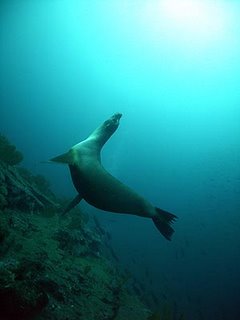
We’re soon rewarded for our bravery: playful sea-lions swim by and I actually manage to keep one’s attention for more than a second by performing some acrobatics too, which, though they must appear as slow-motion clumsy turns to a sea-lion, quickly have me sucking hard on my regulator.
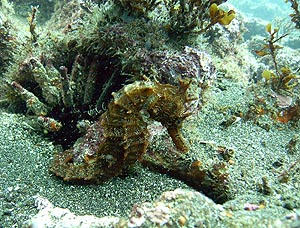
Still recovering my breath, I then turn my camera to some much calmer creatures: three pretty large seahorses, one of them clearly pregnant.
Two hours after the first dive we’re back again. This time I also get to see several stingrays, a sea-turtle, a pair of small penguins passing by just above me before plunging down in hunt-mode and a flightless cormorant torpedoing by, chasing some unidentified small fish.
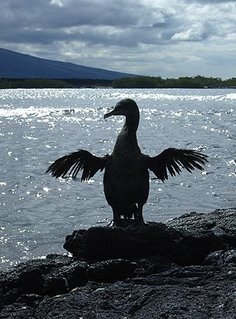
Afternoon walk-about at Punta Espinosa on Fernandina island. The place is crawling with marine iguanas, huddling together by the dozens, in harems jealously guarded by head-shaking salt-spitting males. Flightless cormorants are drying their useless wings.
18:00, we're sailing over the equator as the sun sets and the moon rises above the volcanoes. Another world indeed.
We’re soon rewarded for our bravery: playful sea-lions swim by and I actually manage to keep one’s attention for more than a second by performing some acrobatics too, which, though they must appear as slow-motion clumsy turns to a sea-lion, quickly have me sucking hard on my regulator.
Still recovering my breath, I then turn my camera to some much calmer creatures: three pretty large seahorses, one of them clearly pregnant.
Two hours after the first dive we’re back again. This time I also get to see several stingrays, a sea-turtle, a pair of small penguins passing by just above me before plunging down in hunt-mode and a flightless cormorant torpedoing by, chasing some unidentified small fish.
Afternoon walk-about at Punta Espinosa on Fernandina island. The place is crawling with marine iguanas, huddling together by the dozens, in harems jealously guarded by head-shaking salt-spitting males. Flightless cormorants are drying their useless wings.
18:00, we're sailing over the equator as the sun sets and the moon rises above the volcanoes. Another world indeed.
Sunday, December 3, 2006
Genovesa
We start the day with an early dive, rolling over into a choppy sea at 7:02. It doesn’t take long before a sea-lion joins us, showing off with some incredible underwater acrobatics. Shortly thereafter a hammerhead shark cruises by nonchalantly. In less than 20m of water! They’re not usually seen that shallow, at least not in other parts of the world. And that’s just for starters. As I turn around, an eagle ray flies by down below and a golden cow-nose ray hurries past towards... -I can hardly believe my eyes- a whole school of at least fifty golden cow-nose rays approaching from the opposite direction. And all that before breakfast!

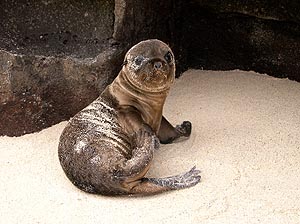
After a fortifying breakfast, Victor takes us for a land tour on Genovesa. We land on a small beach amid a sea-lion family with several cute puppies. Swallow-tail gulls are nesting right beside the path. These are the only gulls in the world that hunt at night. They share the island with masked boobies, red-footed boobies, frigate birds, Galapagos doves and herons. Most of them within touch distance, unafraid of man.
After an amazing first dive, the second dive, at 15:05, in Darwin’s bay, is rather boring, with nothing worth mentioning. But then, with a visibility of about 5m, it’s hard to see much.
After a fortifying breakfast, Victor takes us for a land tour on Genovesa. We land on a small beach amid a sea-lion family with several cute puppies. Swallow-tail gulls are nesting right beside the path. These are the only gulls in the world that hunt at night. They share the island with masked boobies, red-footed boobies, frigate birds, Galapagos doves and herons. Most of them within touch distance, unafraid of man.
After an amazing first dive, the second dive, at 15:05, in Darwin’s bay, is rather boring, with nothing worth mentioning. But then, with a visibility of about 5m, it’s hard to see much.
Saturday, December 2, 2006
M/Y Reina Silvia
At 7:30 I’m transferred to the airport by pick-up, mini-ferry and bus. Pausing along the way for a quick look down one of the pretty deep Gemelos sinkholes. The plane bringing in the other guests is late, but Victor, the main guide, looses no time rounding up everybody and organizing the move to Baltra’s harbor. There, the Gobierno Provincial De Galapagos lets us through without a word and we jump onboard a zodiac for the short ride to the M/Y Reina Silvia, our live-aboard for the next two weeks. We are fifteen tourists on this trip: nine German, one Polish and four Swiss divers, besides yours truly. To take care we get around, get fed, get to see a lot without getting lost above or under water and return happy are ten crew members: captain, first & second mate, cook & assistant, waiter/barman, engineer & assistant, deck-hand and two guides.

Being alone, I get to share a compact cabin with Piotr, a sympathetic Polish guy, who’s also appointed as my dive buddy on this trip.
After a three-course lunch, we’re thoroughly briefed about everything, prepare our gear, suit up and step into the 24°C water directly from the stern of the ship, by now anchored between the two small Plaza islands, on Santa Cruz’s east coast. Just for a short check dive, to get wet and make sure everything is working and we’re properly weighted. In my case that means 6kg of lead, in addition to my 4kg stainless-steel backplate! But then, I’m wearing a very buoyant double 7mm wetsuit.
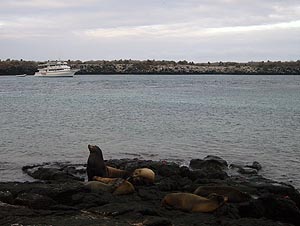
We dive along a shallow coastal edge with sandy bottom. Viz is poor, about 10m. There’re some fish around, but nothing too interesting except for two turtles and a stingray. The sea-lions all seem to be sleeping on shore.
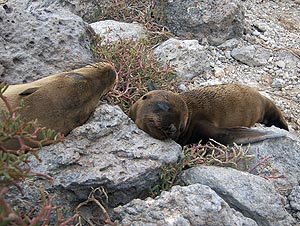
Shortly after the dive we do a quick walk-about on Plaza sur, the same place I visited two days ago. So I get to see the sea-lions again anyway :o)
Being alone, I get to share a compact cabin with Piotr, a sympathetic Polish guy, who’s also appointed as my dive buddy on this trip.
After a three-course lunch, we’re thoroughly briefed about everything, prepare our gear, suit up and step into the 24°C water directly from the stern of the ship, by now anchored between the two small Plaza islands, on Santa Cruz’s east coast. Just for a short check dive, to get wet and make sure everything is working and we’re properly weighted. In my case that means 6kg of lead, in addition to my 4kg stainless-steel backplate! But then, I’m wearing a very buoyant double 7mm wetsuit.
We dive along a shallow coastal edge with sandy bottom. Viz is poor, about 10m. There’re some fish around, but nothing too interesting except for two turtles and a stingray. The sea-lions all seem to be sleeping on shore.
Shortly after the dive we do a quick walk-about on Plaza sur, the same place I visited two days ago. So I get to see the sea-lions again anyway :o)
Subscribe to:
Posts (Atom)